


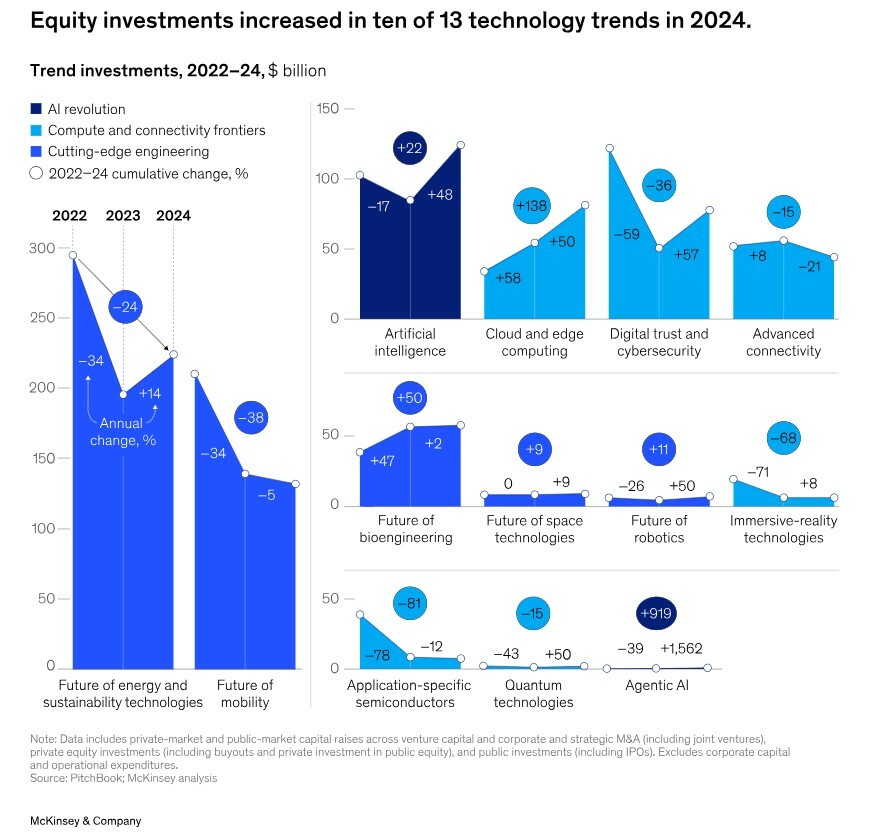
What if your next product strategy was shaped not by one technology but by thirteen converging trends? What would your competitive landscape look like if your rivals were already implementing these technologies while you’re still researching them? McKinsey’s latest Technology Trends Outlook report provides a data-driven roadmap of the frontier technologies poised to reshape business in 2025 and beyond. This isn’t speculative futurism—it’s backed by measurable momentum in patents, equity investments, research publications, and talent demand. For business leaders navigating an increasingly complex digital landscape, understanding these trends isn’t optional—it’s essential for survival and growth.
Why These Tech Trends Matter Now
Today’s business leadership faces unprecedented challenges: navigating complexity, harnessing scale, and building trust amid rapidly blurring digital-physical boundaries. The pace of technological change has accelerated dramatically, with adoption curves compressing from decades to years—or even months. What makes McKinsey’s analysis particularly valuable is its focus on measurable momentum rather than hype. Each trend is evaluated through multiple lenses: innovation (patents and research publications), investment (venture capital and private equity), and talent demand (job postings and skill requirements).
For C-suite executives and innovation leaders, these trends represent both opportunity and imperative. The companies that thrive won’t be those that adopt all thirteen trends, but those that strategically align the right technologies with their business objectives and capabilities.
The 13 Frontier Tech Trends: Overview & Highlights
McKinsey’s analysis identifies thirteen frontier technologies that are driving innovation and addressing critical challenges across sectors. Let’s explore each trend and understand why it matters for your business strategy.
🤖 AI Revolution
1. Agentic AI
At the top of McKinsey’s list is agentic AI—systems that leverage foundation models to perform multi-step tasks on behalf of human users. These AI agents can handle complex workflows with minimal human intervention, representing a significant leap beyond simple chatbots or predictive algorithms.
The business impact is already evident: job postings for agent-related roles surged by a staggering 985% between 2023 and 2024. Companies like Microsoft, Google, and Anthropic are racing to develop increasingly capable AI agents that can automate complex business processes.
2. Artificial Intelligence (Broadly)
Beyond agents, AI systems broadly continue to transform business operations. This encompasses generative AI chatbots, predictive algorithms, and other systems designed to detect patterns across datasets and autonomously refine their performance over time.
What’s notable is how AI is becoming embedded in virtually every business function—from marketing and customer service to supply chain management and product development. The companies seeing the greatest ROI are those integrating AI into core business processes rather than treating it as a separate initiative.

⚙️ Hardware Revolution
3. Application-Specific Semiconductors
Graphics processing units (GPUs) have become the technological cornerstone of the current AI boom, propelling chipmakers like Nvidia to global prominence. McKinsey highlights not only these chips but all semiconductors designed to handle specific tasks as the third-most influential tech trend reshaping the business sector.
The strategic implications are significant: companies with access to specialized computing hardware gain a competitive advantage in AI development and deployment. This is driving massive investments in chip design and manufacturing capacity worldwide.
4. Advanced Connectivity
Technologies like 5G, 6G, and low-Earth-orbit (LEO) satellites are enabling faster, more frictionless means of communication. This advanced connectivity is the foundation for everything from autonomous vehicles to smart cities and remote industrial operations.
For businesses, this means the ability to collect and process data from virtually anywhere, enabling new business models and operational efficiencies that were previously impossible due to connectivity constraints.
🌐 Cloud & Immersive Technologies
5. Cloud & Edge Computing
These are two separate but complementary modalities for processing huge quantities of information. Cloud computing provides virtually unlimited scalability, while edge computing brings processing power closer to data sources for lower latency and reduced bandwidth requirements.
This trend has become increasingly salient for businesses building and deploying their own AI models, which require massive computing resources. The strategic balance between cloud and edge will shape how companies architect their technology infrastructure.
6. Immersive-Reality Technologies
Virtual reality (VR) and augmented reality (AR) technologies continue to evolve beyond their initial consumer applications. While the “metaverse” hype has cooled, practical business applications in training, maintenance, design, and customer experience are gaining traction.
Companies like Meta continue to invest heavily in smart glasses and other immersive technologies, betting that these will eventually become mainstream computing platforms. For businesses, these technologies offer new ways to engage customers and enhance workforce productivity.

🔒 Security & Quantum Technologies
7. Digital Trust & Cybersecurity
As AI systems become more powerful, cybersecurity has been forced to rapidly evolve. Cybercriminals equipped with AI can now launch more sophisticated attacks, while defenders are using the same technologies to detect and respond to threats more effectively.
Many financial institutions, for example, have been fighting fire with fire by upgrading their cybersecurity systems with AI to protect themselves against AI-enhanced cyberattacks. For business leaders, cybersecurity is no longer just an IT concern but a strategic business imperative.
8. Quantum Technologies
Quantum computing leverages the principles of quantum mechanics to execute calculations exponentially quicker than classical computers. While still emerging, quantum technologies are approaching practical applications in areas like materials science, cryptography, and optimization problems.
Forward-thinking companies are already exploring how quantum computing might transform their industries, from pharmaceutical companies accelerating drug discovery to financial firms developing new risk models.

🚗 Robotics & Mobility
9. Future of Robotics
Recent innovations in AI have supercharged the field of robotics, from warehouse automation to humanoid robots capable of complex physical tasks. Building robots that can make decisions in dynamic physical environments is much more complex than training algorithms to detect patterns in text.
Companies like Amazon are leveraging AI to coordinate robot behavior in fulfillment centers, dramatically improving efficiency. As these technologies mature, they promise to transform manufacturing, logistics, healthcare, and other industries reliant on physical labor.
10. Future of Mobility
Beyond self-driving cars, McKinsey highlights advanced drones, e-bikes, and other technologies aimed at improving the efficiency, safety, and sustainability of transportation systems. The mobility sector is undergoing a fundamental transformation driven by electrification, automation, and connectivity.
For businesses, this trend affects not only transportation and logistics companies but any organization with a physical footprint or supply chain. The way people and goods move is changing, creating both challenges and opportunities.
⚛️ Bioengineering, Space & Energy
11. Future of Bioengineering
Emerging technologies like gene editing and synthetic biology are opening new frontiers in healthcare, agriculture, and materials science. McKinsey notes that recent advances achieve “speeds 10 times faster than before,” bringing us closer to lab-grown tissues and organs at scale.
The business implications extend beyond pharmaceutical companies to food producers, chemical manufacturers, and other industries that work with biological systems.
12. Future of Space Technologies
Space is becoming a new frontier for commercial innovation. Companies like SpaceX and Blue Origin are making spaceflight more accessible, while satellite constellations are enabling new communications and Earth observation capabilities.
These technologies have applications ranging from telecommunications and navigation to climate monitoring and precision agriculture.
13. Future of Energy & Sustainability
The final trend encompasses innovations aimed at transforming the global energy landscape toward sustainability. This includes renewable energy sources, energy storage, carbon capture, and clean fuels like hydrogen.
For businesses across all sectors, these technologies offer pathways to reduce environmental impact while potentially lowering energy costs and improving resilience.

Step-by-Step Guide: What Leaders Should Do Now
✅ Step 1: Evaluate Trend Alignment
Not all 13 trends will be equally relevant to your business. Assess which technologies align most closely with your sector, strategy, and capabilities. Consider both the potential impact and your organization’s readiness to adopt each technology.
✅ Step 2: Monitor Momentum Signals
For your priority technologies, establish a systematic approach to tracking innovation, investment, and talent signals. This will help you gauge momentum and timing—moving too early can be as costly as moving too late.
✅ Step 3: Pilot and Scale Strategically
Start with focused pilots in high-impact domains where you can demonstrate clear value. Successful pilots should have a path to scale across the organization, with metrics tied to business outcomes rather than technical implementation.
✅ Step 4: Invest in People
Technology adoption ultimately depends on people. Develop a comprehensive talent strategy that includes upskilling existing employees, attracting new talent, and partnering with external experts where needed.
✅ Step 5: Build Trust Frameworks
As you implement new technologies, especially AI, establish clear governance frameworks that address ethics, privacy, security, and regulatory compliance. Trust is essential for both internal adoption and external acceptance.
Key Actions: Your Technology Trends Checklist
“The future doesn’t wait—it’s engineered today. The companies that thrive won’t be those that adopt all technologies, but those that strategically align the right technologies with their business objectives.”
- Map the 13 trends to your business priorities
- Identify 2-3 technologies for immediate focus
- Develop a 3-year technology roadmap
- Establish metrics to track implementation progress
Strategic Planning
- Assess current capability gaps
- Create targeted upskilling programs
- Recruit for critical emerging roles
- Establish cross-functional innovation teams
Talent & Organization
- Launch pilot projects with clear success criteria
- Develop scaling frameworks for successful pilots
- Establish governance for emerging technologies
- Create feedback loops to adapt strategy as needed
Implementation

Conclusion: Navigating the Future with Confidence
The 13 frontier technologies identified in McKinsey’s Tech Trends 2025 report aren’t passing fads—they’re the foundation of tomorrow’s economy. From AI agents that transform knowledge work to quantum computers that solve previously intractable problems, these technologies are reshaping competitive landscapes across industries.
The question isn’t if your organization will adapt to these changes, but how quickly and effectively you’ll do so. By taking a strategic, measured approach to technology adoption—focusing on business value rather than technology for its own sake—you can navigate this complex landscape with confidence.
Start mapping your technology future today. The companies that thrive will be those that combine technological innovation with organizational agility and a clear vision of how these powerful tools can create value for customers, employees, and shareholders.
Get insights on these technologies. Follow my Blog