


What if your business could solve problems in minutes that would take today’s supercomputers millennia? This isn’t science fiction—it’s the approaching reality of quantum computing. According to McKinsey research, quantum technologies could generate up to $1.3 trillion in value by 2035. The quantum revolution isn’t just coming; it’s already begun, with early adopters positioning themselves to harness unprecedented computational power. For executives and business leaders, the question isn’t if quantum computing will reshape your industry, but whether you’ll be prepared when it does.
The Coming Quantum Shift: Beyond the Hype
Quantum computing represents a fundamental departure from classical computing. While traditional computers process data as binary bits (0s and 1s), quantum computers leverage quantum bits or “qubits” that can exist in multiple states simultaneously. This isn’t just an incremental improvement—it’s a computational paradigm shift that will transform how businesses solve their most complex problems.
⚡ “Quantum computing is like a telescope into problems classical computers can’t even see. It doesn’t just solve existing problems faster—it makes previously impossible calculations possible.”
From Impossible to Inevitable: What Quantum Can Solve
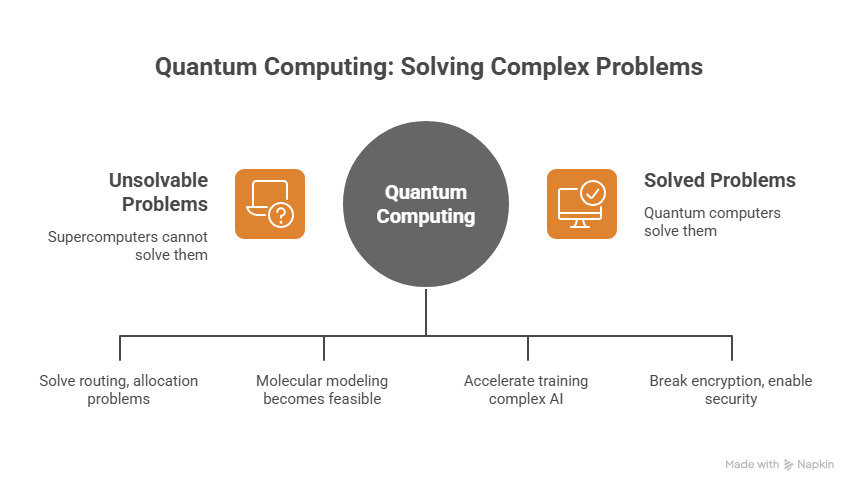
Quantum computing excels at tackling problems that overwhelm even the most powerful supercomputers today:
Complex Optimization
Supply chain routing, financial portfolio optimization, and resource allocation that could take weeks can be solved in minutes.
Advanced Simulations
Molecular modeling for drug discovery and materials science that was previously impossible becomes computationally feasible.
Machine Learning
Training complex AI models that currently require massive computational resources can be dramatically accelerated.
Cryptography
Breaking current encryption standards while enabling new quantum-safe security protocols that protect sensitive data.
Industry Transformation: Who’s Already Moving
| Industry | Quantum Applications | Business Impact | Early Adopters |
| Finance | Risk modeling, fraud detection, portfolio optimization | Reduced risk exposure, higher returns, real-time fraud prevention | JPMorgan Chase, Goldman Sachs, BBVA |
| Pharmaceuticals | Drug discovery, molecular simulation | Accelerated development cycles, reduced R&D costs | Pfizer, Roche, Biogen |
| Logistics | Route optimization, supply chain management | Reduced delivery times, lower operational costs | DHL, FedEx, Maersk |
| Energy | Grid optimization, materials for batteries | Improved efficiency, breakthrough energy storage | ExxonMobil, BP, E.ON |
Government investment is also accelerating, with the U.S. National Quantum Initiative committing billions to quantum research, China investing $10 billion in a quantum research facility, and the EU launching a €1 billion Quantum Technologies Flagship program.
Strategic Imperatives for Business Leaders
While practical, large-scale quantum computers are still developing, the time to prepare is now. Organizations that begin planning for quantum integration will gain significant competitive advantages when the technology reaches commercial viability.

🧠 Build a Quantum-Ready Workforce
The quantum talent gap is already emerging as a critical challenge. Forward-thinking organizations are:
- Identifying key roles that will interface with quantum technologies
- Upskilling existing technical teams in quantum algorithms and applications
- Forming partnerships with academic institutions and quantum service providers
- Creating cross-functional teams that blend quantum expertise with domain knowledge
💼 Create a Quantum Strategy
Quantum initiatives must align with business objectives rather than existing as isolated technology experiments:
- Audit current computational challenges that could benefit from quantum approaches
- Identify high-value use cases specific to your industry and operations
- Develop a roadmap for quantum integration that aligns with technology maturation
- Allocate resources for quantum exploration and pilot projects
🔐 Prepare for Post-Quantum Security
Perhaps the most urgent quantum imperative is cybersecurity preparation:
- Inventory cryptographic systems vulnerable to quantum attacks
- Begin transitioning to post-quantum cryptography standards
- Implement crypto-agility to quickly adapt to emerging security threats
- Develop quantum-safe data protection strategies for sensitive information
Your Quantum Computing Business Impact Action Plan
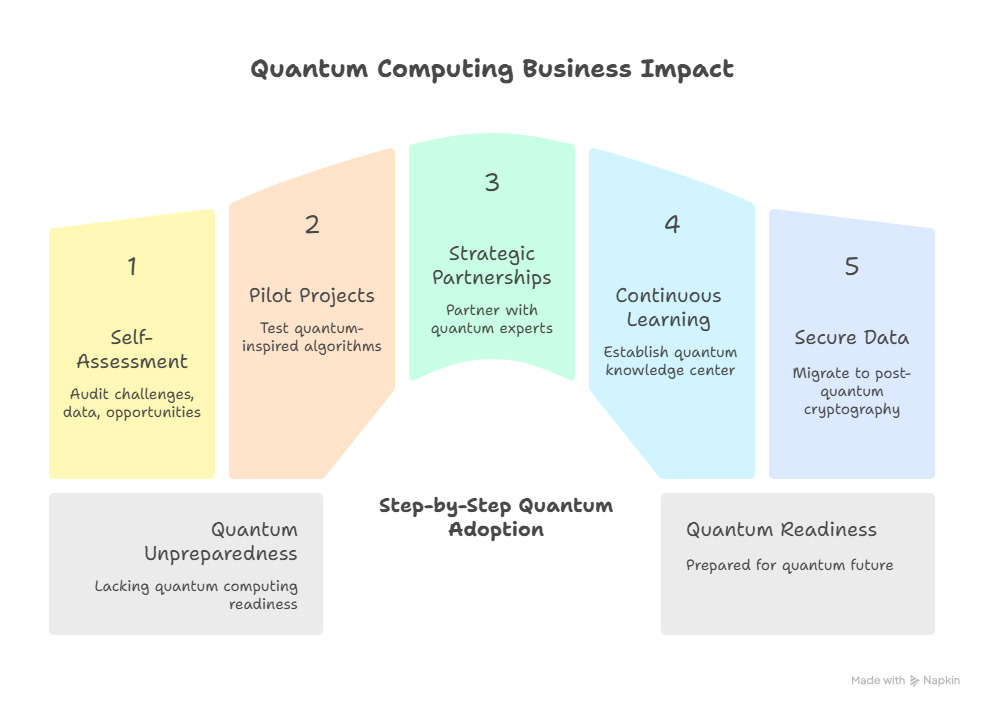
Preparing for the quantum future doesn’t require massive immediate investment. Here’s a practical, step-by-step approach that organizations of any size can implement:
-
✅ Step 1: Self-Assessment
Begin by auditing your organization’s computational challenges, data security protocols, and industry-specific opportunities for quantum advantage. Identify which business processes could benefit most from quantum acceleration.
-
✅ Step 2: Start Small with Pilot Projects
Identify specific optimization problems or machine learning applications that could serve as test cases for quantum approaches. Use quantum-inspired algorithms on classical computers to begin exploring potential benefits.
Pro Tip: Many quantum advantages can be explored today using quantum-inspired algorithms on classical computers, providing a low-risk entry point.
-
✅ Step 3: Form Strategic Partnerships
Rather than building in-house quantum capabilities from scratch, partner with quantum service providers, research institutions, and industry consortia to accelerate your learning curve and access expertise.

-
✅ Step 4: Invest in Continuous Learning
Establish a quantum knowledge center within your organization to track breakthroughs, update your strategy annually, and disseminate insights across departments. Consider appointing a quantum champion to coordinate these efforts.
-
✅ Step 5: Secure Your Data for the Quantum Age
Begin the migration to post-quantum cryptography now, before quantum computers can break current encryption standards. The National Institute of Standards and Technology (NIST) has already selected quantum-resistant cryptographic algorithms that organizations should begin implementing.
Exploring Quantum Without Massive Investment
The emergence of Quantum-as-a-Service (QaaS) platforms has democratized access to quantum computing, allowing businesses to experiment without building their own quantum infrastructure.

Cloud-Based Quantum Services
IBM Quantum Experience
Provides access to real quantum hardware and simulators through the cloud, with a user-friendly interface for running quantum circuits.
Amazon Braket
Offers a single access point to different quantum hardware providers, allowing businesses to experiment with various quantum approaches.
Microsoft Azure Quantum
Combines quantum hardware access with development tools and learning resources in an integrated cloud environment.
Case Study: DHL’s Quantum Logistics Optimization
DHL partnered with D-Wave to explore how quantum computing could optimize delivery routes and warehouse operations. Using D-Wave’s quantum annealing technology, they demonstrated potential for 10-15% efficiency improvements in last-mile delivery—without requiring in-house quantum expertise.

Challenges and Ethical Considerations in Quantum Computing
While quantum computing promises transformative benefits, it also presents significant challenges and ethical considerations that business leaders must address proactively.
Opportunities
- Breakthrough computational capabilities for previously unsolvable problems
- Competitive advantage for early adopters
- New business models and revenue streams
- Enhanced security through quantum-safe cryptography
- Accelerated scientific discovery and innovation
Challenges
- Potential “quantum divide” between early adopters and laggards
- Cybersecurity vulnerabilities during transition to quantum-safe protocols
- Talent shortage and steep learning curve
- Uncertain timeline for commercial quantum advantage
- Ethical concerns around privacy, security, and computational power concentration

The Quantum Divide
As quantum computing matures, organizations that fail to prepare may find themselves at a significant competitive disadvantage. This “quantum divide” could reshape entire industries, with early adopters gaining unprecedented capabilities while laggards struggle to catch up.
“The greatest risk isn’t investing too early in quantum computing—it’s waiting until the technology is mature and finding yourself years behind competitors who started preparing today.”
Ethical Considerations
Business leaders must also consider the ethical implications of quantum computing, particularly in sensitive areas:
Healthcare & Genetic Data
Quantum computing could enable unprecedented analysis of genetic information, raising questions about privacy, consent, and equitable access to quantum-enhanced medical breakthroughs.
Financial Markets
Quantum advantages in trading algorithms could create market imbalances, potentially concentrating wealth among organizations with quantum capabilities.
Quantum Computing Business Impact: Your Readiness Checklist
Use this checklist to assess your organization’s quantum readiness and identify priority areas for action:

Quantum Readiness Checklist
- Industry Assessment: Identify how quantum computing will impact your specific industry and competitive landscape
- Use Case Identification: Document computational challenges that could benefit from quantum approaches
- Security Audit: Inventory cryptographic systems vulnerable to quantum attacks
- Talent Strategy: Develop a plan for acquiring or developing quantum-relevant skills
- Partnership Exploration: Identify potential quantum service providers, research partners, and industry consortia
- Pilot Project Planning: Select 1-2 initial use cases for quantum exploration
- Budget Allocation: Designate resources for quantum initiatives
- Learning Infrastructure: Establish mechanisms for tracking quantum developments
- Executive Education: Ensure leadership understands quantum opportunities and challenges
- Roadmap Development: Create a 3-5 year quantum integration strategy
Conclusion: Preparing for the Quantum Future
Quantum computing isn’t about replacing your IT stack tomorrow—it’s about preparing your organization to thrive when today’s impossible becomes inevitable. The quantum revolution is unfolding now, with breakthroughs accelerating and investments surging.

Organizations that take strategic steps today—building quantum awareness, identifying use cases, forming partnerships, and securing their data—will be positioned to capture enormous value when quantum advantage arrives. Those that wait may find themselves struggling to catch up in a transformed competitive landscape.
The question isn’t if quantum computing will reshape your industry, but whether your business will be ready when it does. The time to begin your quantum journey is now.