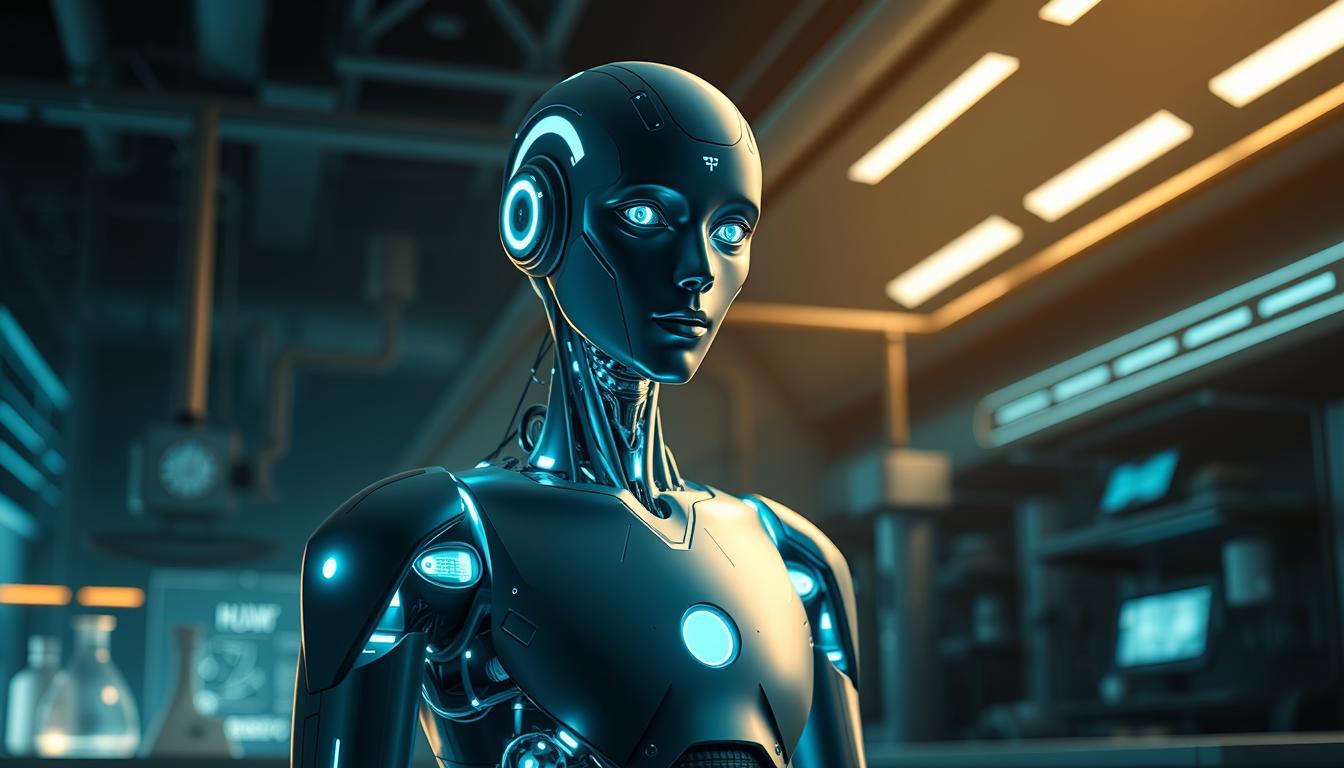


How is artificial intelligence changing our lives and work? What will happen as AI becomes more common?
Technology keeps getting better, and AI applications are showing up everywhere. The global AI market is expected to grow a lot. This change will affect how businesses run and how we live.
Artificial intelligence is making a big difference. It’s making things more efficient and helping us find new ways to solve problems. As we look to the future, it’s important to think about how AI will shape our everyday lives.
Key Takeaways
- The global AI market is projected to grow significantly.
- AI applications are becoming increasingly prevalent in various industries.
- Artificial intelligence is transforming the way businesses operate and people live.
- AI is improving efficiency and enabling innovative solutions.
- The impact of AI is far-reaching, with significant implications for our daily lives.
The Transformative Power of AI

AI is changing the world in many ways, from healthcare to education. It’s making big changes in how we live and work. As artificial intelligence gets better, it’s having a big impact on different areas.
Key Questions About AI’s Impact
As AI becomes more common, we’re asking important questions. For example, how will machine learning change jobs? Will AI help us or hold us back? These questions show we need to understand AI’s good and bad sides. As we look at the workforce, it’s clear that while AI has the potential to automate repetitive tasks, it also creates opportunities for new roles that require human oversight and creativity. The shift in job dynamics could lead to a demand for reskilling and upskilling, ensuring that workers can adapt to the evolving landscape. However, there are concerns about job displacement and the need for policies that support workers during this transition. Thus, it becomes essential to explore both the positive impacts of AI on productivity and innovation, as well as the challenges it poses to employment and job security.
Statistical Insights on AI Adoption
Recent numbers show AI is being used more and more. A report says the AI market could grow by 40% each year. This is because more people want AI technologies in fields like healthcare and finance.
Also, a survey found over 70% of companies are using or planning to use AI. This shows how important AI is becoming, as businesses across various sectors recognize its potential to enhance efficiency, drive innovation, and create competitive advantages. The integration of AI technologies is not limited to just a few industries; it spans healthcare, finance, manufacturing, and beyond, indicating a widespread shift in how organizations operate and make decisions.
A leading expert said, “
AI is not just a technology; it’s a catalyst for change that will reshape our world in ways we’re just beginning to understand. As we continue to explore and develop AI systems, we will uncover new applications and capabilities that can transform everyday life, from automating mundane tasks to solving complex global challenges.
” This view highlights the need for more research and talks about AI’s role in our future, emphasizing the importance of interdisciplinary collaboration and ethical considerations as we advance in this field.
Understanding AI: Core Concepts and Technologies

To fully understand AI, we need to know its basic ideas. AI works thanks to several key technologies that help it function.
Machine Learning: The Engine of Modern AI
Machine Learning (ML) is key to AI. It lets systems learn from data and get better over time. By analyzing vast amounts of information, ML algorithms can identify patterns and trends that may not be immediately apparent to human observers. This capability enables ML to assist in various tasks, such as predicting what will happen next and making recommendations just for you. For instance, in e-commerce, ML can analyze your browsing history and preferences to suggest products that you are likely to buy, enhancing your shopping experience. Moreover, as these systems are exposed to more data, they continuously refine their algorithms, leading to improved accuracy and efficiency in their predictions and decisions.
Deep Learning and Neural Networks
Deep Learning is a part of ML that uses Neural Networks to understand complex data. These networks are like the human brain, with layers that help process information. Each layer in a neural network consists of interconnected nodes, or neurons, that work together to analyze and interpret data. As the data passes through these layers, the network learns to recognize patterns and features, allowing it to make increasingly accurate predictions. This hierarchical learning process is particularly effective for tasks involving large datasets, such as image and speech recognition, where traditional algorithms may struggle. By leveraging vast amounts of data, deep learning models can uncover intricate relationships within the data, making them invaluable for applications across various industries.
Natural Language Processing and Computer Vision
Natural Language Processing (NLP) lets AI systems understand and create human language. This is how chatbots and language translators work. Computer Vision helps AI make sense of pictures and videos. It’s used in things like facial recognition and self-driving cars.
| AI Technology | Description | Applications |
|---|---|---|
| Machine Learning | Enables systems to learn from data | Predictive analytics, personalized recommendations |
| Deep Learning | Analyzes complex data patterns using neural networks | Image recognition, speech recognition |
| NLP | Enables AI to understand and generate human language | Chatbots, language translation |
| Computer Vision | Interprets visual data from images and videos | Facial recognition, autonomous vehicles |
Knowing these core ideas and technologies is crucial. It helps us see where AI is now and where it might go in the future.
How AI is Transforming Industries

AI is changing how businesses work. It’s not just a trend. It’s a big change in how we do things.
Artificial intelligence is making things better. It’s driving innovation and making things more efficient. It’s also making customer experiences better across different sectors.
Healthcare Revolution Through AI
In healthcare, AI is helping a lot. It’s making tools that can look at medical images better and faster than doctors. For example, AI can spot early signs of diseases like cancer from images, significantly improving the chances of successful treatment. These advanced algorithms analyze patterns in imaging data, allowing for more accurate diagnoses and quicker decision-making. This capability is especially vital in critical care settings, where timely intervention can save lives.
Real-world Application: Companies like IBM Watson Health are using AI. They’re analyzing big data to find new treatments and help patients get better. By leveraging vast amounts of patient data, these systems can identify trends and suggest personalized treatment plans that cater to individual needs, ultimately enhancing patient outcomes and streamlining healthcare processes.
AI in Finance and Banking
The finance world is using AI too. It’s making things safer, catching fraud, and giving better banking services. AI chatbots are helping with customer support by providing instant responses to common inquiries, thereby reducing wait times for customers. Algorithms are checking transactions to find any odd activities, analyzing vast amounts of data in real-time to detect anomalies that may indicate fraudulent behavior. Additionally, machine learning models are being employed to assess credit risk more accurately, enabling lenders to make informed decisions while minimizing potential losses.
“AI is changing finance. It lets banks make better decisions, manage risks, and connect with customers better.”
Manufacturing and Supply Chain Optimization
AI is making manufacturing better. It predicts when things need fixing, so there’s less downtime. This means factories can work more efficiently.
| Industry | AI Application | Benefit |
|---|---|---|
| Healthcare | Diagnostic Tools | Early Disease Detection |
| Finance | Fraud Detection | Enhanced Security |
| Manufacturing | Predictive Maintenance | Reduced Downtime |
Retail and Customer Experience
In retail, AI is making things personal. It uses recommendation engines and chatbots. These help stores know what customers like and offer them what they want.
By using AI, businesses can innovate, work better, and give customers a better experience. It’s changing the game in many industries.
AI in Everyday Life

AI is changing our daily lives in big ways. It’s making homes smarter, assistants more helpful, and entertainment more tailored to us. We see this change in how we live and what we enjoy.
Smart Home Technologies
AI-powered smart home devices are boosting home security, comfort, and energy use. They learn and adjust to our likes, changing lights, temperature, and security settings. These devices can include smart thermostats that optimize heating and cooling based on our daily routines, smart locks that enhance security by allowing remote access and monitoring, and smart lighting systems that can be programmed or controlled via voice commands or mobile apps. By integrating with other home systems, they create a cohesive environment that responds to our needs, ensuring a seamless and efficient living experience. As they continue to evolve, these technologies are not only making our homes more secure and energy-efficient but also significantly enhancing our overall quality of life.
Virtual Assistants and Chatbots
Virtual assistants like Siri, Alexa, and Google Assistant are getting more popular. They let us do tasks, get info, and control devices just by talking. These smart assistants are designed to understand natural language, making interactions feel more intuitive and seamless. For instance, users can ask them to set reminders, play music, provide weather updates, or even control smart home devices with simple voice commands. As technology advances, these assistants are also becoming better at learning from user preferences, allowing for more personalized experiences. This means that over time, they can anticipate our needs and suggest actions that enhance our daily routines, making them invaluable tools for efficiency and convenience.
AI-Powered Entertainment and Content Creation
AI is changing the entertainment world. It offers personalized shows that cater to individual preferences, analyzing viewing habits to suggest content that resonates with each user. Additionally, it creates content on its own, using algorithms to write scripts, compose music, and even produce entire films, showcasing the creative potential of technology. Furthermore, it makes experiences like AR and VR more real, allowing users to engage in interactive storytelling and immersive environments that blur the lines between reality and fiction, transforming how we experience entertainment.
Ethical Considerations and Privacy Concerns
As AI spreads, worries about privacy, data safety, and ethics grow. We must tackle these issues to make sure AI helps everyone.
| AI Application | Benefits | Challenges |
|---|---|---|
| Smart Home Devices | Enhanced convenience, energy efficiency | Data privacy, security risks |
| Virtual Assistants | Hands-free control, personalized assistance | Data collection, potential for bias |
| AI-Powered Entertainment | Personalized recommendations, immersive experiences | Content homogenization, job displacement |
In conclusion, AI is making a big difference in our lives. It brings many benefits but also raises big questions about ethics and privacy. As AI keeps growing, we must face these challenges to make sure it benefits everyone fairly.
Top 5 Books on AI from Amazon

Looking to explore artificial intelligence? Here are the top 5 AI books on Amazon. They offer different views and insights into AI’s complex world.
Essential Reads for Understanding Artificial Intelligence
These books are chosen for their importance, impact, and high Amazon ratings. They cover AI’s future, its good and bad sides, and how it affects us.
Generative AI System Design Interview
Designing generative AI (GenAI) systems for interviews can be complex and challenging. This book offers a clear and structured approach to help you tackle a wide range of GenAI system design questions. It provides a practical framework and real-world examples to make learning these concepts easier.
This book complements our ML System Design Interview book. While the first book focuses on topics such as search and recommendation systems, this one centers on generative systems, with detailed examples and explanations to help you understand how GenAI systems are built in practice.
Designing Machine Learning Systems: An Iterative Process for Production-Ready Applications
Machine learning systems are both complex and unique. Complex because they consist of many different components and involve many different stakeholders. Unique because they’re data dependent, with data varying wildly from one use case to the next. In this book, you’ll learn a holistic approach to designing ML systems that are reliable, scalable, maintainable, and adaptive to changing environments and business requirements.
Machine Learning System Design Interview
Machine learning system design interviews are the most difficult to tackle of all technical interview questions. This book provides a reliable strategy and knowledge base for approaching a broad range of ML system design questions. It provides a step-by-step framework for tackling an ML system design question. It includes many real-world examples to illustrate the systematic approach, with detailed steps you can follow.
AI Engineering: Building Applications with Foundation Models
Recent breakthroughs in AI have not only increased demand for AI products, they’ve also lowered the barriers to entry for those who want to build AI products. The model-as-a-service approach has transformed AI from an esoteric discipline into a powerful development tool that anyone can use. Everyone, including those with minimal or no prior AI experience, can now leverage AI models to build applications. In this book, author Chip Huyen discusses AI engineering: the process of building applications with readily available foundation models.
Artificial Intelligence For Dummies
Artificial intelligence is swiftly moving from a sci-fi future to a modern reality. This edition of Artificial Intelligence For Dummies keeps pace with the lighting-fast expansion of AI tools that are overhauling every corner of reality. This book demystifies how artificial intelligence systems operate, giving you a look at the inner workings of AI and explaining the important role of data in creating intelligence.
Together, these books give a deep look at AI’s current state and future. They are must-reads for anyone curious about AI.
Conclusion: The Future of AI and Human Collaboration
AI is changing how we live and work, showing great benefits. It’s making industries better, helping businesses work smarter and faster.
AI helps drive new ideas, better customer service, and makes things easier. We must focus on using AI wisely. It should help us, not take our jobs.
The future looks bright with AI and humans working together. We’ll see big improvements in healthcare, finance, and education. By using AI well, we can make a better world for all.