

Are neural networks changing our world? These networks are complex, but their role in AI is clear. With the AI market expected to hit $190 billion by 2025, knowing about architecture is key. This architecture encompasses various layers and nodes that process information, allowing machines to learn from data patterns and make decisions. Understanding how these networks function is crucial for developing more effective AI applications across different sectors.
The role of neural networks in AI is growing fast. As AI needs rise, so does the need to grasp their components. This includes not only the basic structure but also the algorithms that drive learning and optimization. As industries increasingly rely on AI for innovation and efficiency, a solid foundation in these components becomes essential for anyone looking to contribute to or understand the future of technology..
Key Takeaways
- The significance of neural networks in modern AI is substantial.
- Understanding neural network architecture is vital for AI development.
- The global AI market is projected to reach $190 billion by 2025.
- Neural networks are becoming increasingly complex.
- The demand for AI solutions is driving the need for knowledge about neural networks.
The Power Behind Modern AI

Modern AI owes its power to neural networks. These systems are like the human brain, learning and adapting. They are very good at many tasks.
Are Neural Networks Revolutionizing Our World?
Yes, neural networks are changing our world. They help in healthcare, finance, transportation, and education. They can handle lots of data and make smart predictions.
How Complex Are Neural Networks Really?
Neural networks are very complex. They have many layers and thousands of nodes or “neurons.” Each layer processes information at different levels of abstraction, allowing the network to learn intricate patterns and relationships within the data. The backpropagation algorithm trains them by adjusting them to get better. This algorithm works by calculating the gradient of the loss function, which measures how far the network’s predictions are from the actual outcomes, and then propagating these errors backward through the network to update the weights of the connections between neurons.
What Makes Neural Networks Different from Traditional Computing?
Neural networks are different from old computers. They learn from data and get better over time. This makes them great for recognizing patterns and making predictions, like in image and speech recognition.
Improving neural networks is key to their success. This involves neural network optimization to make them more accurate.
Components of Neural Networks
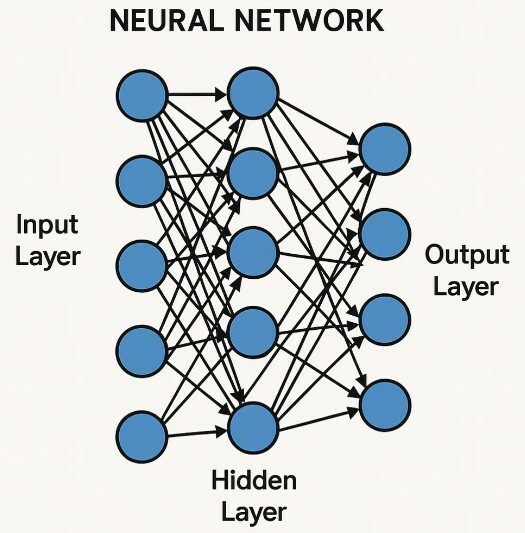
Neural networks work well because of their parts, like neurons and their connections. These parts help the networks process and create data.
Neurons: The Fundamental Processing Units
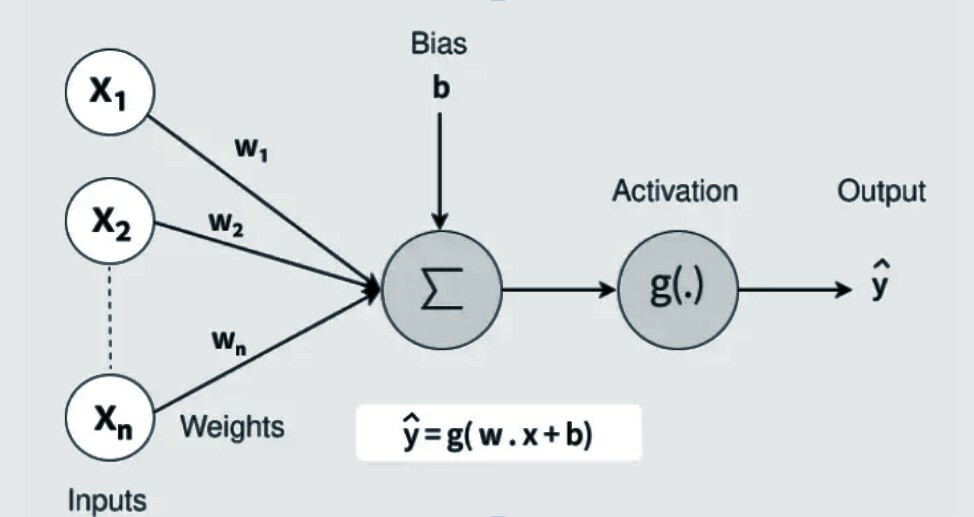
Neurons, or perceptrons, are the core units of neural networks. They take in data, do calculations, and then send out results. This is key to how networks learn and predict things. Each neuron processes inputs through an activation function, which determines whether the neuron should be activated based on the weighted sum of its inputs. This process allows the network to capture complex relationships in the data, making it possible to learn from various types of information, including images, sounds, and text.
Weights and Biases: Fine-tuning the Network
Weights and biases are vital for neuron outputs. Weights adjust the input data, and biases shift the output. Changing these during training helps the network perform better. Weights are learned through a process called backpropagation, where the network calculates the error in its predictions and adjusts the weights accordingly to minimize this error. Biases allow the model to fit the data more flexibly, enabling it to account for systematic errors in the input data. Together, weights and biases play a crucial role in enhancing the model’s accuracy and ensuring that it generalizes well to unseen data.
Connections and Topology: The Network Architecture
The architecture of a neural network is crucial. It’s how neurons connect that lets the network learn. Different setups, like feedforward or recurrent, are better for different tasks.
The network’s structure, like layer number and neuron connections, affects its ability to handle complex data. By understanding and setting up these parts well, developers can use neural networks for many tasks.
- Feedforward Networks: Good for tasks where data moves only one way, from input to output.
- Recurrent Neural Networks (RNNs): Best for handling sequential data or forecasting over time.
Neural Network Layers and Their Functions
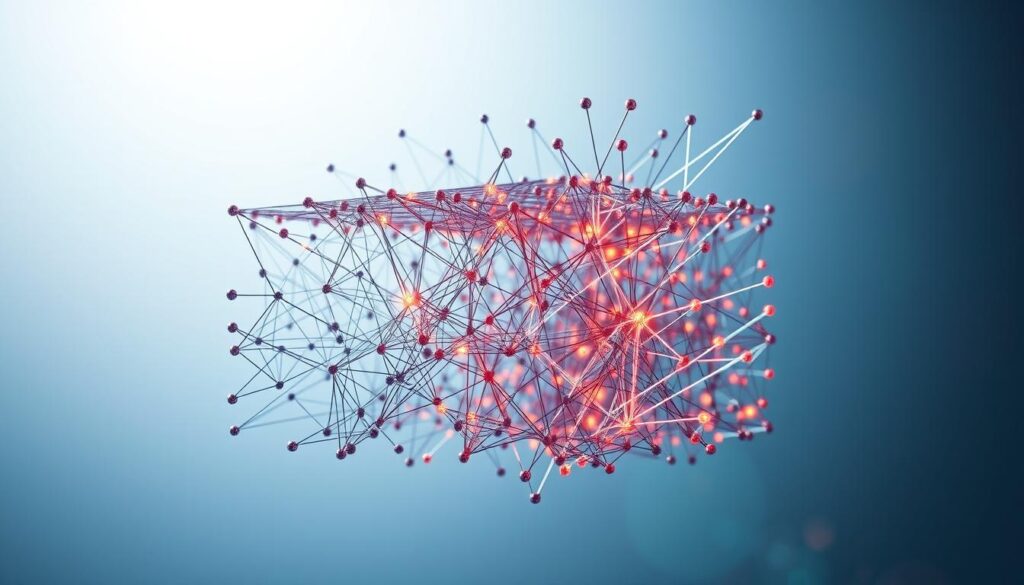
Neural networks work because of their layered structure. These layers change inputs into useful forms. They help with tasks like recognizing images and understanding language.
Input Layer: Gateway for Data
The input layer is where data first meets the network. It sends the data to other layers for processing. The number of neurons here matches the input data’s features.
Hidden Layers: The Computational Engine
Hidden layers do the hard work. They turn data into abstract forms that the network can learn from. These layers are called “hidden” because you can’t see them directly.
Single vs. Multiple Hidden Layers
The number of hidden layers matters a lot. Simple tasks might need just one layer. But, more complex tasks need more layers to find the hidden patterns.
Output Layer: Delivering Predictions
The output layer makes the final prediction. It uses information from earlier layers. The setup of this layer depends on the task it’s doing.
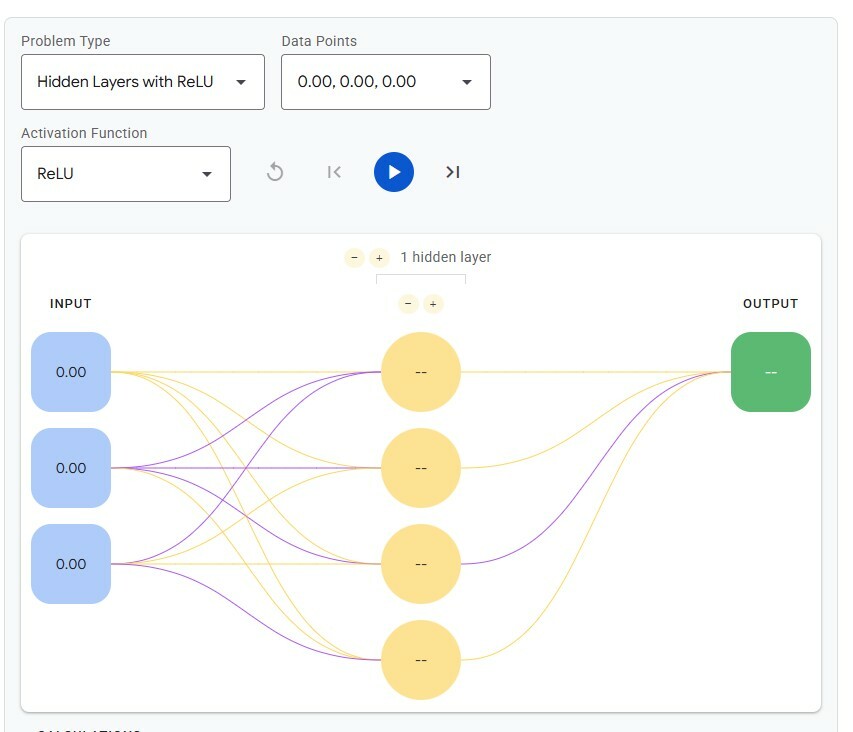
You can practise in this website LINK where you will find various tools and resources designed to help you deepen your understanding of neural networks. Engaging with interactive tutorials and exercises allows you to apply theoretical concepts in practical scenarios, enhancing your learning experience. By experimenting with different configurations and datasets, you can see firsthand how adjustments affect the performance of the neural network. This hands-on practice is crucial for mastering the complexities of machine learning and developing the skills necessary to tackle real-world problems effectively.
Interpreting Neural Network Outputs
It’s important to know what a neural network is saying. For tasks like classifying, the output layer gives out probabilities. This helps us see how well the network is doing.
| Layer Type | Function | Activation Function |
|---|---|---|
| Input Layer | Receives input data | None |
| Hidden Layers | Performs complex computations | ReLU, Sigmoid, Tanh |
| Output Layer | Generates final output | Softmax, Sigmoid |
Activation Functions and Learning Algorithms

In neural networks, activation functions and learning algorithms are key. They help the network learn complex relationships. Activation functions add non-linearity, making the network more powerful.
Essential Activation Functions
Activation functions are vital for neural networks. They introduce non-linearity, which is crucial for learning complex data.
Sigmoid, ReLU, and Tanh Functions
The sigmoid function maps inputs to a probability between 0 and 1, making it particularly useful for binary classification tasks. Its S-shaped curve means that it can compress any input value into a value that can be interpreted as a probability. However, it can suffer from the vanishing gradient problem, where gradients become very small, hindering learning in deep networks. ReLU (Rectified Linear Unit) outputs the input if it’s positive or zero, allowing for faster training and reducing the likelihood of the vanishing gradient issue. It introduces sparsity in the network, as it effectively turns off neurons that output negative values. Tanh (hyperbolic tangent) maps inputs to a range between -1 and 1, providing a stronger gradient than the sigmoid function and centering the data, which can lead to faster convergence during training. Each function has its own strengths and weaknesses, making the choice of activation function crucial depending on the specific architecture and task at hand.
The Backpropagation Algorithm Explained
The backpropagation algorithm trains neural networks by reducing the error between predictions and actual outputs. It does this by moving the error backwards through the network, adjusting weights and biases at each layer. This process involves calculating the gradient of the loss function with respect to each weight by applying the chain rule, which allows the algorithm to efficiently update weights in the direction that minimizes the error. Backpropagation is essential for deep learning, as it enables the training of networks with many layers, allowing them to learn complex patterns in data.
Optimization Techniques for Neural Networks
Optimization techniques are crucial for training neural networks efficiently. They adjust the network’s parameters to reduce the loss function, which measures how well the network’s predictions match the actual data. Various strategies exist to enhance the optimization process, such as using momentum to accelerate gradients in the right direction, which can help overcome local minima. Additionally, techniques like learning rate scheduling can adapt the learning rate during training, improving convergence rates and overall performance.
Gradient Descent and Modern Optimizers
Gradient descent is a basic optimization algorithm that moves the network’s parameters in the right direction. Modern optimizers like Adam, RMSProp, and Adagrad improve upon this. They offer faster convergence and better performance in some cases by adapting the learning rate based on the average of recent gradients, which helps to navigate the optimization landscape more effectively. These advanced techniques allow for more robust training of complex models, making them indispensable in the field of deep learning.
Real-World Applications and Implementation

Neural networks are changing many fields, from computer vision to healthcare. They learn from complex data, making them key in today’s tech world.
Computer Vision and Image Recognition
Convolutional Neural Networks (CNNs) have changed computer vision. They help with facial recognition, object detection, and self-driving cars.
Natural Language Processing and Text Analysis
Recurrent Neural Networks (RNNs) and their types, like LSTMs, are crucial in NLP. They help with language translation, understanding feelings in text, and summarizing content.
Predictive Analytics in Business
Neural networks help predict trends in business. They help companies improve customer service and run more efficiently.
Healthcare and Medical Diagnostics
In healthcare, neural networks help diagnose diseases. They analyze medical images and patient data for early detection and tailored treatments.
| Application Area | Neural Network Type | Key Benefits |
|---|---|---|
| Computer Vision | CNNs | Accurate image recognition, object detection |
| NLP | RNNs/LSTMs | Language translation, sentiment analysis |
| Predictive Analytics | Feedforward Networks | Trend forecasting, decision-making |
| Healthcare | CNNs/RNNs | Disease diagnosis, personalized treatment |
Top 5 Books on Neural Networks

Looking to explore neural networks more? Here are the top 5 books for a deep dive.
Deep Learning by Ian Goodfellow et al.
This book introduces deep learning from the basics to advanced techniques. You can find it on Amazon at https://amzn.to/45aDmwG.
Neural Networks and Deep Learning by Michael Nielsen
Nielsen’s book dives deep into neural networks and deep learning. It focuses on the math behind it. Check it out on Amazon link
| Book Title | Author | Amazon Link |
|---|---|---|
| Hands-On Machine Learning with Scikit-Learn, Keras, and TensorFlow | Aurélien Géron | Shop now |
| Deep Learning with Python | François Chollet | Shop now |
| Pattern Recognition and Machine Learning | Christopher Bishop | Shop now |
These books cover a wide range of topics. They go from theory to practical use. They’re great for anyone interested in neural network architecture and components of neural networks.
Neural Networks: Unlocking Future Technologies
Neural networks have changed the game in artificial intelligence. They let machines learn and decide like us. The key parts talked about here, like optimizing and training neural networks, are vital for their success.
Knowing the parts, layers, and how they work helps developers make advanced models. These models are key to innovation in fields like computer vision and healthcare. They also help in predictive analytics.
As research keeps moving forward, neural networks will open up new tech and change our lives and work. Training and optimizing these networks well is key to getting accurate and reliable results.