

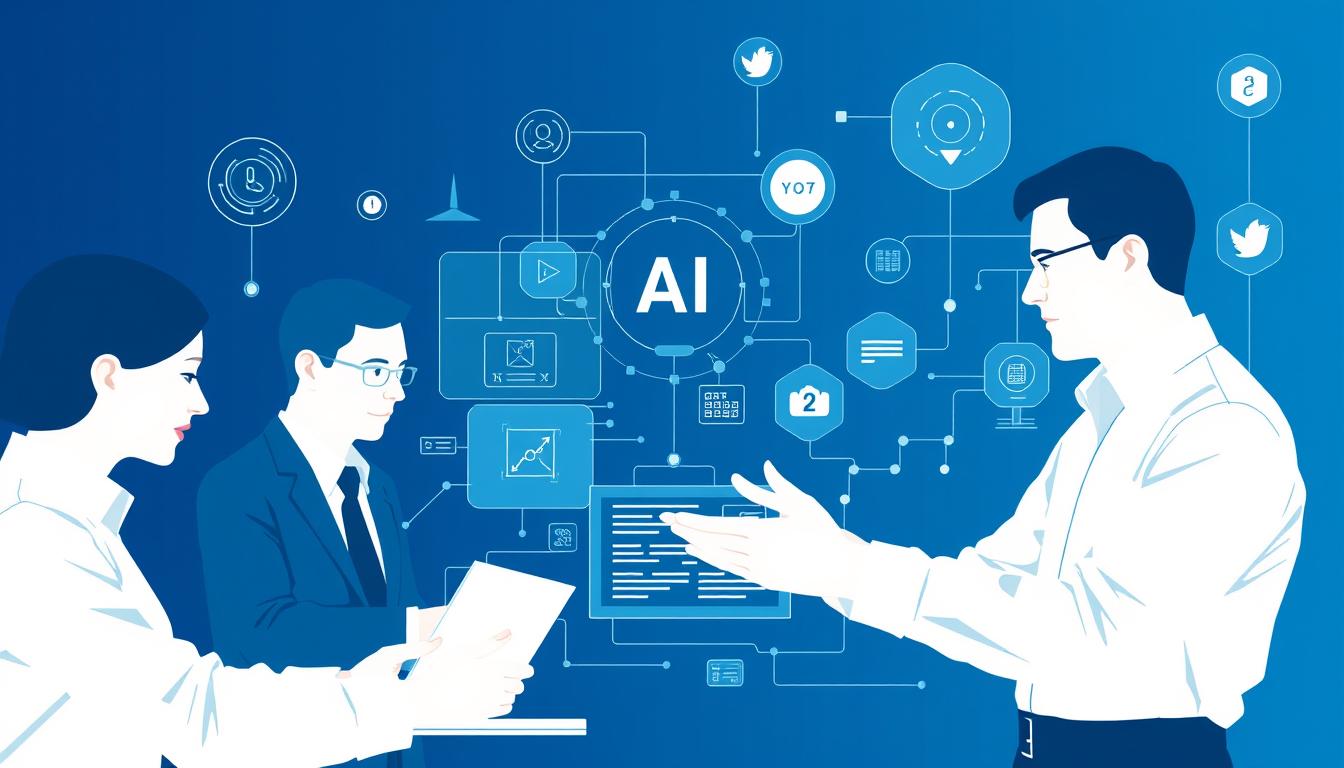
What if the real risk of AI isn’t job loss—but leadership failure? What if companies fall behind not because they lack technology, but because they lack cultural readiness? And are you truly prepared to lead humans and machines together?
As artificial intelligence transforms industries at an unprecedented pace, the true differentiator isn’t access to technology—it’s leadership capability. AI is not just a tech challenge—it’s a leadership evolution challenge that requires a fundamental rethinking of how we organize, motivate, and develop our teams.
How to Create an AI-Friendly Culture
Leaders must cultivate an environment where AI is viewed as an ally rather than a threat. This requires intentional cultural development that balances technological advancement with human strengths.
🧠 Normalize Experimentation and Learning
AI-first leaders understand that perfection is the enemy of progress. They create safe spaces for teams to experiment with AI tools, learn from failures, and share insights across the organization. This approach transforms AI from a theoretical concept into a practical tool that teams can leverage daily.
Consider how Microsoft encourages its employees to use AI tools for routine tasks while documenting both successes and failures in shared knowledge bases. This collaborative approach accelerates learning across the organization.
⚡ Replace Fear with Education
Leaders must acknowledge that AI anxiety is real and address it head-on. Rather than dismissing concerns, effective leaders invest in comprehensive education programs that demystify AI and help employees understand its capabilities and limitations.
“AI won’t replace humans—but humans with AI will replace humans without AI.”
✅ Encourage Cross-Functional Collaboration
AI implementation cannot be siloed within IT departments. Leaders must foster collaboration between technical teams and business units to ensure AI solutions address real business challenges. This cross-pollination of expertise creates more effective solutions and broader organizational buy-in.
🤖 Reward Curiosity Over Certainty
In rapidly evolving technological landscapes, curiosity becomes more valuable than certainty. Leaders should reward those who ask insightful questions, challenge assumptions, and continuously seek to understand how AI can enhance their work. This mindset shift creates a culture of continuous learning essential for AI adaptation.
🌍 Promote Psychological Safety
Employees must feel safe expressing concerns, asking questions, and making mistakes as they adapt to AI tools. Leaders who create psychologically safe environments see faster adoption rates and more innovative applications of AI across their organizations.
The Difference: A token AI initiative might involve purchasing AI tools without changing how teams work. A truly AI-ready organization transforms its culture, processes, and leadership approaches to integrate AI as a core capability rather than a bolt-on technology.
How AI Changes Business Structure
The integration of AI into organizations demands structural shifts that go beyond simple automation. Leaders must reimagine organizational design to leverage both human creativity and AI capabilities.
🔄 From Hierarchies to Agile Networks
Traditional command-and-control structures struggle to adapt quickly enough in AI-powered environments. Forward-thinking organizations are shifting toward networked structures where cross-functional teams form around specific challenges and disband when solutions are implemented.
📊 Data-Driven Micro-Decision-Making
AI enables decision-making to be pushed to the edges of organizations, where employees closest to customers and operations can leverage real-time insights. This requires flatter structures and greater autonomy for frontline teams.
🧠 New Hybrid Roles
The most effective organizations are creating hybrid roles that blend domain expertise with AI literacy. These “translators” bridge the gap between technical capabilities and business applications, ensuring AI solutions address real business needs.
⚙️ Process Automation
As AI automates routine tasks, organizations must shift from task-based roles to outcome-focused positions. This requires rethinking job descriptions, performance metrics, and career development paths to emphasize strategic thinking and creative problem-solving.
🌍 Ethics & Governance Functions
Leading organizations are establishing dedicated ethics and governance functions to ensure responsible AI use. These teams develop frameworks for data privacy, algorithmic transparency, and bias mitigation that guide AI implementation across the enterprise.
📱 Continuous Learning Infrastructure
AI-ready organizations invest in learning platforms that enable continuous skill development. These systems use AI to personalize learning pathways based on individual roles, strengths, and organizational needs.
Before vs. After AI Adoption: Financial Services Example
Before: Centralized risk assessment teams working with quarterly data updates, strict departmental boundaries, and limited customer personalization.
After: Distributed risk intelligence with real-time monitoring, cross-functional teams organized around customer journeys, and hyper-personalized offerings based on AI-powered insights.
AI Use Across Business Units
Effective AI implementation requires tailored approaches for different business functions. Leaders must understand how AI can transform each department while ensuring cross-functional alignment.
Marketing: Beyond Basic Personalization
AI enables marketers to move beyond simple demographic targeting to predictive engagement strategies based on behavioral patterns and contextual signals. The most responsible applications focus on delivering genuine value rather than manipulation.
Key Application: Content optimization systems that automatically adjust messaging based on real-time performance data while maintaining brand voice and ethical standards.
Sales: Intelligence-Driven Engagement
AI transforms sales from intuition-based to intelligence-driven by identifying high-potential prospects, recommending optimal engagement strategies, and predicting customer needs before they’re articulated.
Key Application: Conversation intelligence systems that analyze customer interactions to identify patterns in successful deals and coach sales teams on effective approaches.
Operations: Predictive Optimization
AI enables operations teams to shift from reactive problem-solving to predictive optimization. Machine learning models can identify potential bottlenecks, recommend process improvements, and automatically adjust resource allocation based on changing conditions.
Key Application: Digital twins that simulate physical processes to optimize performance and predict maintenance needs before failures occur.
Finance: Risk Intelligence
AI transforms financial operations by detecting subtle patterns that indicate fraud, optimizing cash management, and generating scenario models that inform strategic decisions.
Key Application: Anomaly detection systems that identify unusual transactions while reducing false positives that create friction for legitimate customers.
HR: Talent Analytics
AI helps HR teams identify talent patterns that predict success, create personalized development paths, and design compensation structures that optimize both performance and retention.
Key Application: Bias detection tools that identify and mitigate unconscious bias in hiring, promotion, and compensation decisions.
Customer Service: Augmented Support
AI enables customer service teams to provide more personalized, efficient support by automating routine inquiries and providing agents with real-time recommendations for complex issues.
Key Application: Agent assist tools that listen to customer conversations and suggest relevant information and solutions without replacing human judgment.
Methods & Techniques for Business Differentiation
While AI technology itself is increasingly commoditized, how organizations apply it creates sustainable competitive advantage. Leaders must focus on unique applications that deliver distinctive value.
💡 Create Better Customer Experiences
AI enables hyper-personalization at scale, allowing organizations to tailor experiences to individual preferences while maintaining operational efficiency. The key differentiator is using AI to enhance rather than replace human touchpoints.
Example: Stitch Fix combines AI-powered recommendations with human stylists to create a personalized shopping experience that neither humans nor algorithms could deliver alone.
📦 Customize Products at Scale
AI makes mass customization economically viable across industries. Organizations can offer personalized products without the traditional cost premiums associated with customization.
Example: Adidas uses AI to design and manufacture custom shoes based on individual biomechanics, creating products uniquely suited to each customer’s needs.
📊 Offer Predictive Insights
Organizations that leverage AI to anticipate customer needs and market shifts gain significant advantages. The differentiation comes from combining AI predictions with domain expertise to take preemptive action.
Example: John Deere uses AI to analyze soil conditions and weather patterns, helping farmers optimize planting decisions before problems arise.
⚡ Improve Speed While Maintaining Quality
AI enables organizations to dramatically accelerate processes without sacrificing quality. This creates competitive advantage through faster innovation cycles and more responsive customer service.
Example: Moderna used AI to design its COVID-19 vaccine in just two days, demonstrating how AI can compress timelines for complex development processes.
Remember: AI alone isn’t differentiation — how you use it is. The most successful organizations integrate AI into their existing competitive advantages rather than treating it as a standalone capability.
Ethical Challenges & Risks of AI
Responsible AI leadership requires proactive identification and management of ethical risks. Leaders who address these challenges systematically gain trust advantages while avoiding potential reputational damage.
⚖️ Algorithmic Bias
AI systems can perpetuate and amplify existing biases when trained on historical data that reflects societal inequities. Leaders must implement rigorous testing protocols to identify and mitigate bias before deployment.
Mitigation Strategy: Diverse development teams and regular bias audits using multiple fairness metrics across different demographic groups.
🔍 Lack of Transparency
Complex AI models often function as “black boxes,” making it difficult to understand how they reach specific conclusions. This opacity creates risks for accountability and trust.
Mitigation Strategy: Explainable AI approaches that provide interpretable rationales for decisions, especially in high-stakes contexts.
🔐 Data Privacy Concerns
AI systems require vast amounts of data, creating tensions between functionality and privacy. Leaders must balance innovation with robust data governance.
Mitigation Strategy: Privacy-preserving techniques like federated learning and differential privacy that enable AI development without centralizing sensitive data.
👥 Workforce Displacement
While AI creates new opportunities, it also automates tasks that previously provided employment. Responsible leaders develop transition strategies that help employees adapt to changing skill requirements.
“The question isn’t whether AI will transform jobs—it’s how leaders will transform their organizations to create new forms of value that combine human and machine capabilities.”
Synthesizing Learning into Action
✔ Ethics Committees
Establish cross-functional ethics committees with diverse perspectives to review AI initiatives before deployment. These groups should have real authority to modify or halt projects that present significant ethical risks.
✔ Bias Audits
Implement regular testing protocols that evaluate AI systems for potential bias across different demographic groups and use cases. These audits should be conducted by teams independent from the development group.
✔ Training Programs
Develop comprehensive ethics training for all employees involved in AI development and deployment. These programs should cover both technical approaches to ethical AI and broader societal implications.
✔ Accountability Structures
Create clear lines of responsibility for AI outcomes, ensuring that specific leaders are accountable for both the benefits and potential harms of AI systems deployed under their oversight.
Strategic Advantage: Organizations that proactively address ethical considerations gain trust advantages with customers, employees, and regulators. This trust translates into competitive differentiation as AI becomes more pervasive.
Real-World Mini-Stories: Success and Failure
Success: Responsible AI Implementation
When a global financial institution decided to implement AI for credit decisions, they took a deliberate approach focused on both performance and fairness. Before deployment, they:
- Established a diverse AI ethics board with authority to veto algorithms
- Conducted extensive testing across different demographic groups
- Created transparent explanations for all decisions
- Implemented human review processes for edge cases
The result? Their AI system not only improved approval rates for qualified applicants but also reduced disparities across demographic groups. Customer trust increased, regulatory reviews were positive, and the company gained market share in previously underserved segments.
Failure: Rushed AI Adoption
A retail chain eager to implement AI-powered hiring faced significant backlash after rushing deployment without adequate testing. Their system:
- Was trained primarily on data from existing employees
- Perpetuated historical hiring biases
- Lacked transparency in decision-making
- Was implemented without adequate change management
The result was a public relations crisis when the algorithm was found to systematically disadvantage certain demographic groups. The company faced legal challenges, employee trust plummeted, and they ultimately abandoned the system after significant reputational damage.
Common Mistakes Leaders Make
Even well-intentioned leaders often fall into predictable traps when implementing AI. Awareness of these common pitfalls is the first step toward avoiding them.
❌ Treating AI as an IT Project
AI initiatives that remain siloed within technology departments rarely deliver their full potential. Successful implementations require cross-functional leadership and integration with core business processes.
Better Approach: Establish multidisciplinary teams with both technical expertise and deep business domain knowledge.
❌ Failing to Reskill Employees
Organizations often invest heavily in AI technology while underinvesting in the human capabilities needed to leverage it effectively. This creates both resistance and capability gaps.
Better Approach: Develop comprehensive learning journeys that help employees at all levels build relevant AI skills and adaptability.
❌ Ignoring Human Impact
Leaders sometimes focus exclusively on efficiency gains without considering how AI will affect employee experience, team dynamics, and organizational culture.
Better Approach: Conduct thorough impact assessments that consider both operational and human dimensions of AI implementation.
❌ Using AI Without Governance
Implementing AI without clear governance frameworks creates significant risks related to data privacy, security, and algorithmic bias.
Better Approach: Establish robust governance structures before deployment, including clear policies, oversight mechanisms, and accountability measures.
❌ Believing Speed Matters More Than Responsibility
The pressure to implement AI quickly often leads organizations to cut corners on testing, validation, and change management—creating long-term problems that outweigh short-term gains.
Better Approach: Adopt an iterative implementation approach that balances speed with thorough validation and responsible deployment.
❌ Chasing Capabilities Without Clear Objectives
Many organizations implement AI because competitors are doing so, without clearly defining the specific business problems they aim to solve.
Better Approach: Start with well-defined business challenges and evaluate how AI might address them, rather than starting with the technology.
Leadership Action Checklist
Use this checklist to assess your organization’s readiness for AI implementation and identify priority areas for leadership development.
✅ Build AI Curiosity, Not Fear
- Create safe spaces for experimentation
- Celebrate learning from AI initiatives
- Share success stories across the organization
- Provide accessible education on AI fundamentals
- Address concerns transparently
✅ Adapt Structures for Hybrid Work
- Redesign roles around outcomes, not tasks
- Create cross-functional AI integration teams
- Establish clear data governance frameworks
- Develop new performance metrics for AI-augmented work
- Build ethics and governance capabilities
✅ Identify Best AI Use by Department
- Map current pain points and opportunities
- Prioritize use cases with clear ROI
- Start with augmentation, not replacement
- Implement measurement frameworks
- Create feedback loops for continuous improvement
✅ Use AI to Differentiate Intentionally
- Identify your unique value proposition
- Focus AI investments on enhancing core strengths
- Develop metrics that capture customer experience impact
- Create feedback mechanisms to drive continuous improvement
✅ Prioritize Ethics and Responsibility
- Establish AI ethics principles
- Implement bias testing protocols
- Create transparent documentation practices
- Develop clear accountability structures
Conclusion: Leading in the Age of AI
The integration of AI into organizations represents one of the most significant leadership challenges of our time. The technology itself, while powerful, is increasingly commoditized. The true differentiator lies in how leaders navigate the human dimensions of this transformation.
Organizations that thrive in the AI era will be those where leaders successfully blend technological capabilities with human strengths—creating cultures where experimentation flourishes, structures that enable agility, and governance frameworks that ensure responsible innovation.
The journey toward AI-enabled leadership is not a destination but a continuous evolution. It requires developing new capabilities, rethinking organizational structures, and maintaining a steadfast commitment to both performance and responsibility.