

Your company talks about AI—but is it actually using it? What separates organizations merely experimenting with AI from those truly transforming through it? The difference isn’t about buying the latest software or hiring data scientists—it’s about leadership that fundamentally changes how an organization learns, decides, and executes. AI adoption is a marathon of trust, not a sprint of technology.
The Leadership Imperative for AI Adoption 🧭
Leadership, not technology, ultimately determines AI success. While 65% of organizations report using generative AI regularly, according to McKinsey, only 37% see high productivity improvements. This gap exists because successful AI adoption requires more than just implementing tools—it demands strategic leadership.
As a business leader driving AI adoption, you must fulfill three critical roles:
AI doesn’t replace leaders—it redefines leadership itself. The most successful AI transformations occur when leaders view artificial intelligence not as a technical initiative but as a business capability that requires cross-functional collaboration and cultural change.
Common Barriers to AI Adoption ⚠️
Before we explore how to drive AI adoption, let’s understand what typically stands in the way. These barriers manifest across industries but can be overcome with the right leadership approach.
Lack of Strategic Clarity
Many organizations pursue AI without clear business objectives. They chase technology for technology’s sake, resulting in scattered pilots that fail to deliver measurable value. A financial services firm invested heavily in AI chatbots without defining success metrics, leading to low adoption and questionable ROI.
Pilot Paralysis
Organizations get stuck in endless experimentation, unable to scale promising AI initiatives beyond initial pilots. A manufacturing company developed an AI quality control system that showed 15% defect reduction in tests but struggled to implement it across multiple production lines due to lack of cross-functional support.
Data Silos and Poor Infrastructure
Fragmented data environments and legacy systems prevent AI from accessing the quality information it needs. A healthcare provider’s predictive analytics project stalled because patient data was trapped in disconnected systems with inconsistent formats and governance.
Fear and Trust Deficit
Employee resistance stems from job displacement fears and lack of trust in AI systems. A retail chain’s inventory optimization AI was technically sound but faced widespread rejection from store managers who didn’t understand its recommendations and feared losing control.
The Framework for Driving AI Adoption 🚀
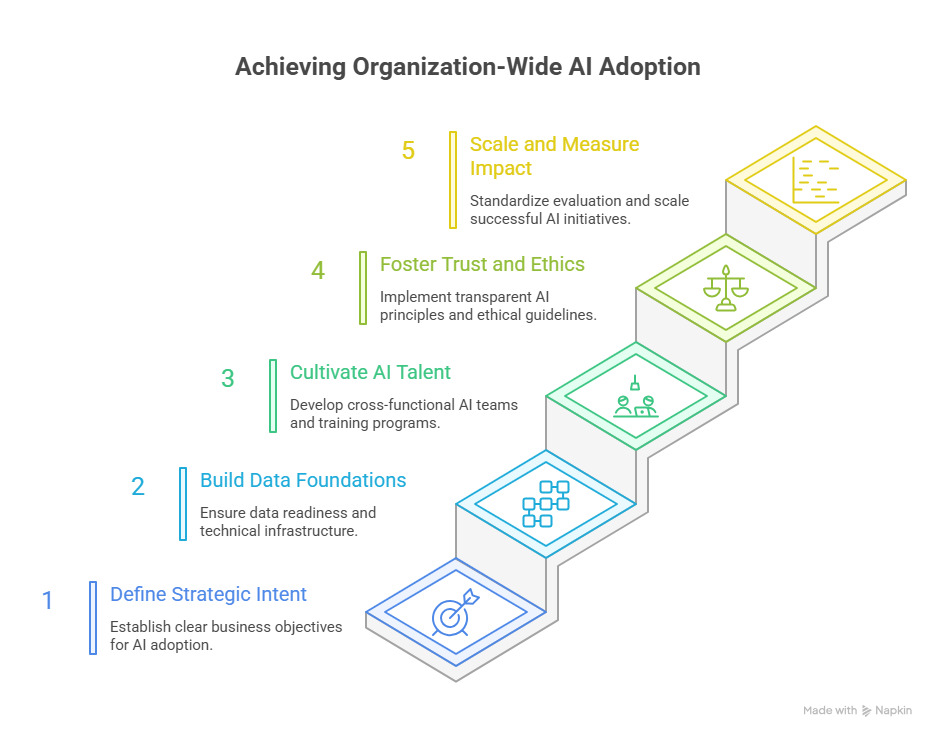
Moving from isolated AI experiments to organization-wide adoption requires a structured approach. This five-step framework provides business leaders with a roadmap for successful AI transformation.
Step 1: Define Strategic Intent 🧭
Successful AI adoption begins with clear business objectives, not technology. Start by identifying specific business challenges where AI can create measurable value:
“The organizations that thrive with AI don’t ask ‘How can we use this technology?’ They ask ‘Which business outcomes matter most, and how might AI help achieve them?'”
Align each AI initiative with specific KPIs to ensure you can measure success in business terms, not technical metrics. This creates accountability and helps secure ongoing support from stakeholders.
Step 2: Build Data and Technology Foundations ⚙️
AI is only as good as the data that powers it. Before scaling AI, ensure your organization has:
Data Readiness
Technical Infrastructure
Start with a data maturity assessment to identify gaps and prioritize improvements. Remember that perfect data isn’t required to begin—but you should understand your limitations and have a plan to address them as you scale.
Step 3: Cultivate AI Talent and Mindset 🧠
AI adoption requires both technical expertise and business understanding. Build capabilities through:

Focus on developing “translators” who can bridge the gap between technical capabilities and business needs. These individuals help ensure AI solutions address real problems and can be successfully implemented within existing workflows.
Step 4: Foster Trust and Ethical Governance ⚖️
Sustainable AI adoption requires trust from both employees and customers. Establish:
“Trust is the currency of successful AI adoption. Without it, even the most sophisticated algorithms will be rejected or underutilized.”
Balance automation with human oversight, especially in decisions that affect people. This creates confidence in AI systems while maintaining accountability and the human judgment that AI cannot replace.
Step 5: Scale and Measure Impact 📈
Move beyond pilots by creating mechanisms to identify, validate, and scale successful AI initiatives:
Celebrate and communicate wins to build momentum. When teams see tangible benefits from AI adoption, they become more willing to embrace change and explore new applications.
Real-World Examples of Successful AI Adoption 💼
Let’s examine how business leaders have successfully driven AI adoption in different industries, focusing on their leadership approaches rather than just the technology.
Logistics: From Pilot to Enterprise-Wide Transformation
A global logistics company struggled with route optimization across its fleet of 5,000+ vehicles. Multiple AI pilots showed promise but failed to scale.
Leadership Approach:
Results:
The company achieved a 15% emissions reduction and 12% cost savings within 18 months. Driver satisfaction increased as they gained confidence in the AI system’s recommendations.
Financial Services: Balancing Innovation with Regulation
A mid-sized bank wanted to implement AI-driven credit assessment while maintaining regulatory compliance and avoiding bias.
Leadership Approach:
Results:
The bank reduced default rates by 23% while increasing approval rates for qualified applicants by 15%. Loan processing time decreased by 40% while maintaining full regulatory compliance.

Key Leadership Behaviors for Successful AI Adoption 🤖
Beyond frameworks and strategies, specific leadership behaviors significantly impact AI adoption success. Leaders who excel at driving AI transformation consistently demonstrate these qualities:
💡 Lead with Curiosity
Effective AI leaders approach the technology with genuine curiosity rather than assumptions. They ask “what could AI enable?” instead of prescribing specific solutions. This mindset encourages exploration and helps identify unexpected opportunities for value creation.
🤝 Foster Collaboration
AI adoption requires breaking down silos between technical teams and business units. Successful leaders create forums for cross-functional collaboration, ensuring AI solutions address real business needs and can be effectively implemented within existing workflows.
🧭 Communicate Vision
The best AI leaders articulate a compelling vision that connects AI initiatives to broader business goals. They translate technical capabilities into business outcomes, helping stakeholders understand the “why” behind AI adoption, not just the “what” and “how.”
🌱 Create Psychological Safety
AI adoption involves experimentation and learning. Leaders must create environments where teams feel safe to test new approaches, make mistakes, and share honest feedback about what’s working and what isn’t.
📊 Celebrate Progress
Successful AI adoption is a journey with many milestones. Effective leaders recognize and celebrate incremental wins, helping build momentum and demonstrating the value of continued investment in AI capabilities.
⚖️ Balance Speed and Governance
The most effective AI leaders find the right balance between moving quickly to capture value and establishing appropriate governance to manage risks. They understand when to accelerate and when to proceed with caution.
“The leaders who drive successful AI adoption don’t just understand the technology—they understand how to create the conditions for their organizations to learn, adapt, and grow with AI.”
Common Mistakes to Avoid in AI Adoption 🚫
Even well-intentioned leaders can fall into traps that derail AI adoption. Being aware of these common pitfalls can help you navigate around them:
Treating AI as Purely an IT Initiative
When AI is delegated entirely to technical teams without business leadership, it often results in solutions that don’t address real business needs or integrate with existing workflows. Successful AI adoption requires active partnership between technical and business leaders.
Ignoring Change Management
Many organizations focus exclusively on the technical aspects of AI while neglecting the human side of adoption. Without proper communication, training, and involvement, employees may resist AI systems regardless of their technical merit.
Underinvesting in Data Readiness
Organizations often rush to implement AI without addressing fundamental data quality, accessibility, and governance issues. This leads to poor model performance and erodes trust in AI systems. Successful adoption requires appropriate investment in data foundations.
Equating Success with Automation
Many leaders mistakenly view AI success as eliminating human involvement. The most effective AI implementations augment human capabilities rather than replace them, combining the strengths of both artificial and human intelligence.
AI Adoption Leadership Checklist ✅
Use this checklist to assess your organization’s readiness for AI adoption and identify areas that need attention:
Conclusion: Leading the AI-Enabled Organization 🚀
AI adoption isn’t about replacing human intelligence—it’s about amplifying it. The organizations that thrive will be those where leaders use AI not just to make better decisions, but to create smarter, more human-centered enterprises.
Successful AI adoption requires a delicate balance: between innovation and governance, between technical capability and human judgment, between ambition and pragmatism. Business leaders who navigate these tensions effectively will unlock unprecedented value from AI while building organizations that are more adaptive, insightful, and competitive.
As you reflect on your own AI adoption journey, consider: How ready is your organization to move from AI potential to AI performance? What leadership actions could you take today to accelerate progress?
“The difference between AI as a buzzword and AI as a business driver comes down to leadership. Not just any leadership—but leadership that combines strategic vision, human empathy, and relentless execution.”
Frequently Asked Questions About AI Adoption for Business Leaders
How long does successful AI adoption typically take?
The timeline for AI adoption varies based on organizational readiness, complexity of use cases, and existing data maturity. Initial pilots can show results in 3-6 months, but comprehensive transformation typically takes 18-36 months. The key is to balance quick wins with long-term capability building.
What skills should business leaders develop to drive AI adoption?
While technical literacy is helpful, business leaders don’t need to become AI experts. More important are skills in change management, cross-functional collaboration, data-driven decision making, and ethical reasoning. Understanding AI’s capabilities and limitations is more valuable than knowing how to build models.
How should we measure the success of our AI initiatives?
Success should be measured primarily through business outcomes rather than technical metrics. Define KPIs tied to strategic objectives—such as cost reduction, revenue growth, customer satisfaction, or operational efficiency—and track how AI initiatives impact these metrics. Also measure adoption rates and user satisfaction to ensure the solutions are being effectively utilized.
How can we address employee concerns about AI replacing jobs?
Address concerns through transparent communication about how AI will augment rather than replace human work. Involve employees in identifying AI use cases and implementation planning. Invest in reskilling programs that help employees develop capabilities that complement AI. Celebrate examples where AI has enhanced jobs by removing tedious tasks and enabling more valuable work.