

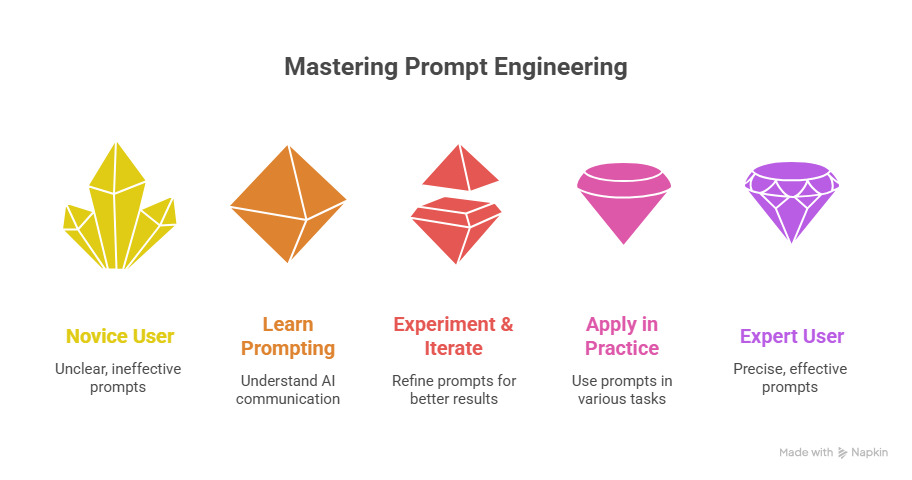
As AI tools like ChatGPT, Claude, and Gemini become increasingly integrated into our daily workflows, the ability to craft effective prompts has emerged as a critical skill that separates average results from extraordinary ones. In this guide, we’ll explore the art and science of prompt engineering, providing you with practical techniques to dramatically improve your AI interactions.
Why Prompt Engineering Matters
Think of AI as a brilliant intern—it can do almost anything, but only if you give clear, thoughtful instructions. The difference between average and expert AI users often comes down to how they ask questions and frame their requests.
When you master prompt engineering, you’ll experience:
- Time savings — Get accurate results on your first attempt instead of going through multiple frustrating iterations
- Enhanced creativity — Unlock AI’s ability to generate novel ideas and perspectives you might not have considered
- More accurate outputs — Receive responses that precisely match your needs and expectations
- Consistent results — Develop repeatable formulas for different types of AI tasks
As large language models (LLMs) continue to evolve, prompt engineering is quickly becoming a must-have skill in business, education, content creation, and research. This emerging discipline involves crafting precise and effective prompts that can unlock the full potential of AI systems. Those who master this skill gain a significant advantage in productivity and problem-solving capabilities. By understanding how to communicate with AI effectively, users can harness its power to streamline workflows, generate innovative solutions, and enhance decision-making processes. Moreover, as AI tools become increasingly integrated into various sectors, the ability to create well-structured prompts will distinguish proficient users from those who struggle to leverage these technologies. This mastery not only leads to better outputs but also fosters a deeper understanding of the capabilities and limitations of AI, making it an invaluable asset in today’s digital landscape.
The Core Principles of Effective Prompt Engineering
💡 Clarity: Be Specific About What You Want
Vague prompts lead to vague responses. The more specific you are about what you want, the better the AI can deliver. Instead of asking for “information about climate change,” specify “three recent scientific findings about Arctic ice melt and their implications for coastal communities.”
“The quality of your prompt determines the quality of your response. Be as clear and specific as possible about what you want the AI to do.”
🧠 Context: Give the AI Background Information
Providing context helps the AI understand the situation and generate more relevant responses. This can include specifying a role for the AI to adopt (e.g., “Act as a marketing strategist”), providing background information, or explaining your goals.
For example: “You are an experienced marketing strategist helping a small organic skincare brand appeal to environmentally conscious millennials. The brand’s unique selling point is its plastic-free packaging.”
⚙️ Constraints: Define Format, Tone, or Length
Setting constraints guides the AI’s output format and style. Specify elements like:
- Word or character count: “Write in 3 paragraphs, under 300 words”
- Tone: “Use a conversational, friendly tone”
- Format: “Structure this as a bulleted list with 5-7 points”
- Audience: “Explain this to a 10-year-old”
🚀 Iteration: Refine Your Prompt Based on Results
Prompt engineering is rarely perfect on the first try. View it as a collaborative process where you refine your prompts based on the AI’s responses. If you don’t get what you want, try again with a more specific or differently structured prompt.
Remember that you can build on previous responses by asking the AI to “revise the previous response to be more concise” or “expand on the third point with more examples.”
Step-by-Step Guide to Mastering Prompt Engineering
✅ Step 1: Understand Your Goal
Before writing any prompt, clarify exactly what you want to achieve. Are you looking for information, creative ideas, analysis, or something else? The more precise your goal, the better your prompt will be.
Ask yourself: What specific outcome am I looking for? What would a perfect response look like?
✅ Step 2: Provide Context and Role
Tell the AI who it is and what role it’s playing. This technique, sometimes called “role prompting,” helps frame the AI’s perspective and expertise.
“You are an experienced financial advisor specializing in retirement planning for middle-income families.”
This context primes the AI to draw on relevant knowledge and adopt an appropriate tone for the specified role.
✅ Step 3: Add Constraints and Parameters
Define the boundaries of what you want: format, length, tone, audience, and any specific requirements.
“Write a 500-word blog introduction about sustainable fashion. Use a conversational tone appropriate for environmentally conscious millennials. Include 3 statistics and end with a thought-provoking question.”
✅ Step 4: Request Examples or Structures
Guide the output by requesting specific structures or examples. This is particularly useful for complex outputs.
For instance: “Structure this email template with the following sections: 1) Greeting, 2) Problem statement, 3) Our solution, 4) Proposed next steps, 5) Call to action.”
✅ Step 5: Iterate and Refine
If the initial response isn’t quite right, don’t start over—iterate! Ask the AI to modify specific aspects of its response:
- “Make this explanation simpler, suitable for a high school student.”
- “Rewrite this in a more professional tone.”
- “Expand on the second point with two specific examples.”
Each iteration gets you closer to your desired output, and you’ll learn what works for future prompts.
Real-World Examples of Great vs. Weak Prompts
❌ Weak Prompt
“Write about leadership.”
Why it’s weak: Too vague, no context, format, or audience specified. The AI has to guess what aspect of leadership to focus on and how to structure the response.
✅ Strong Prompt
“Write a 300-word LinkedIn post about servant leadership that emphasizes humility, includes one quote from a well-known business leader, and ends with a motivational question for readers. The tone should be professional but conversational.”
Why it’s strong: Specifies topic, length, platform, key points, structural elements, and tone. The AI has clear guidelines to follow.
❌ Weak Prompt
“Explain AI.”
Why it’s weak: Too broad, no indication of depth, audience, or purpose. Could result in anything from a technical explanation to a philosophical discussion.
✅ Strong Prompt
“Explain artificial intelligence to a 10-year-old using a cooking analogy. Keep it under 150 words and use simple language without technical jargon.”
Why it’s strong: Specifies audience (10-year-old), approach (cooking analogy), length constraint, and style requirements (simple language, no jargon).
❌ Weak Prompt
“Give me email template.”
Why it’s weak: No information about the purpose of the email, the audience, tone, or key points to include.
✅ Strong Prompt
“Create an email template for a software company following up with clients 30 days after purchase. The email should check if they’re satisfied with the product, offer assistance with any issues, and subtly mention the upcoming premium features. Use a friendly but professional tone and keep it under 200 words.”
Why it’s strong: Provides context (software company), purpose (30-day follow-up), key elements to include, tone guidance, and length constraint.
Common Prompt Engineering Mistakes to Avoid
⚠️ Being Too Vague
Vague prompts like “Write something interesting” or “Tell me about marketing” force the AI to make too many assumptions about what you want.
Fix: Be specific about topic, scope, and purpose. “Write a 500-word blog post about email marketing strategies for small e-commerce businesses in 2024.”
⚠️ Ignoring Tone or Format
Without guidance on tone or format, the AI will default to a generic, often formal style that might not match your needs.
Fix: Explicitly state the desired tone and format. “Use a conversational, friendly tone and structure this as a bulleted list with brief explanations.”
⚠️ Asking for Too Many Things in One Prompt
Overloaded prompts with multiple requests often result in incomplete or confused responses as the AI tries to address everything at once.
Fix: Break complex requests into separate prompts or clearly number multiple requests. “First, provide three headline options. After I select one, we’ll work on the body copy.”
⚠️ Not Refining or Following Up
Accepting the first response without iteration often means missing out on better results that could be achieved with simple refinements.
Fix: View prompt engineering as a conversation. Follow up with specific refinement requests: “That’s a good start. Can you make the language more concise and add a concrete example for each point?”
Tools, Books & Resources to Master Prompt Engineering
Ready to take your prompt engineering skills to the next level? These carefully selected resources will help you master the art of communicating with AI.
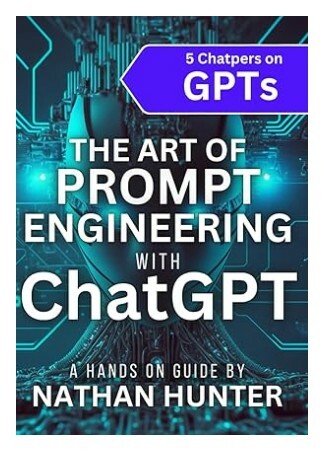
The Art of Prompt Engineering with ChatGPT
This comprehensive guide walks you through advanced techniques for crafting prompts that get exceptional results from ChatGPT and other large language models.
Price: $24.99
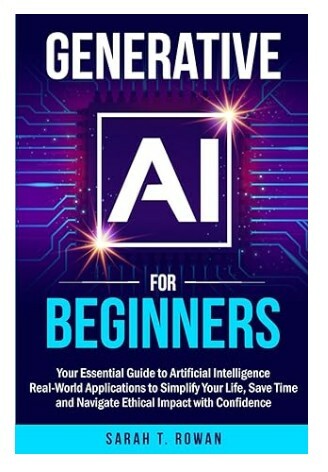
Generative AI for Beginners
Perfect for newcomers to AI, this accessible guide explains the fundamentals of prompt engineering and provides step-by-step instructions for getting started with various AI tools.
Price: $19.99

The Age of AI: And Our Human Future
This forward-looking guide explores advanced prompt engineering techniques, including chain-of-thought prompting, few-shot learning, and prompt chaining for complex tasks.
Price: $19.99
Get Started with Kindle Unlimited
Access many of these prompt engineering resources and thousands of other books with a Kindle Unlimited subscription.
Checklist Summary — Quick Actions for Better Prompts
📋 Your Prompt Engineering Routine
- Define the outcome — Be crystal clear about what you want to achieve
- Give the AI context and role — Set the stage with background information
- Add tone and structure — Specify format, style, and presentation
- Include examples or constraints — Guide the AI with examples or boundaries
- Refine, test, and improve — Iterate based on results
Pro Tip: Save your most effective prompts in a personal “prompt library” for reuse. This helps you build a collection of proven templates for different tasks.
“Prompt engineering isn’t about talking to machines—it’s about learning to think more clearly yourself.”
Conclusion: Your Journey to AI Mastery Begins with Better Prompts
AI is only as powerful as the prompts behind it. The better you communicate with AI systems, the smarter they become for your specific needs. By mastering prompt engineering, you’re not just learning to use a tool—you’re developing a new way of thinking that enhances your problem-solving abilities across all domains. This skill allows you to tailor your interactions with AI, ensuring that the outputs you receive are relevant and aligned with your goals. It’s about crafting your queries in a way that maximizes the potential of AI, enabling it to assist you more effectively in various tasks.
Remember that becoming skilled at prompt engineering is a journey. Start with the basics, practice regularly, and gradually incorporate more advanced techniques. Each interaction with AI is an opportunity to refine your approach and learn what works best for different situations. As you progress, you will discover nuances in how AI interprets different prompts, which can lead to more innovative solutions and insights. The learning process itself can be incredibly rewarding, as it not only enhances your technical skills but also boosts your confidence in utilizing AI as a powerful ally in your work.
As AI continues to evolve, your ability to communicate effectively with these systems will become an increasingly valuable skill. Whether you’re using AI for work, education, or creative pursuits, mastering prompt engineering will help you achieve extraordinary results that stand out in an AI-powered world.
This article includes affiliate links. If you purchase products through these links, we may earn a small commission at no additional cost to you.