
What happens when human creativity meets machine intelligence—not in competition, but in collaboration? This question sits at the heart of a revolution quietly transforming how organizations think, plan, and innovate. Welcome to the era of Superminds—where the collective intelligence of people and computers working together creates possibilities neither could achieve alone.
What Are Superminds?
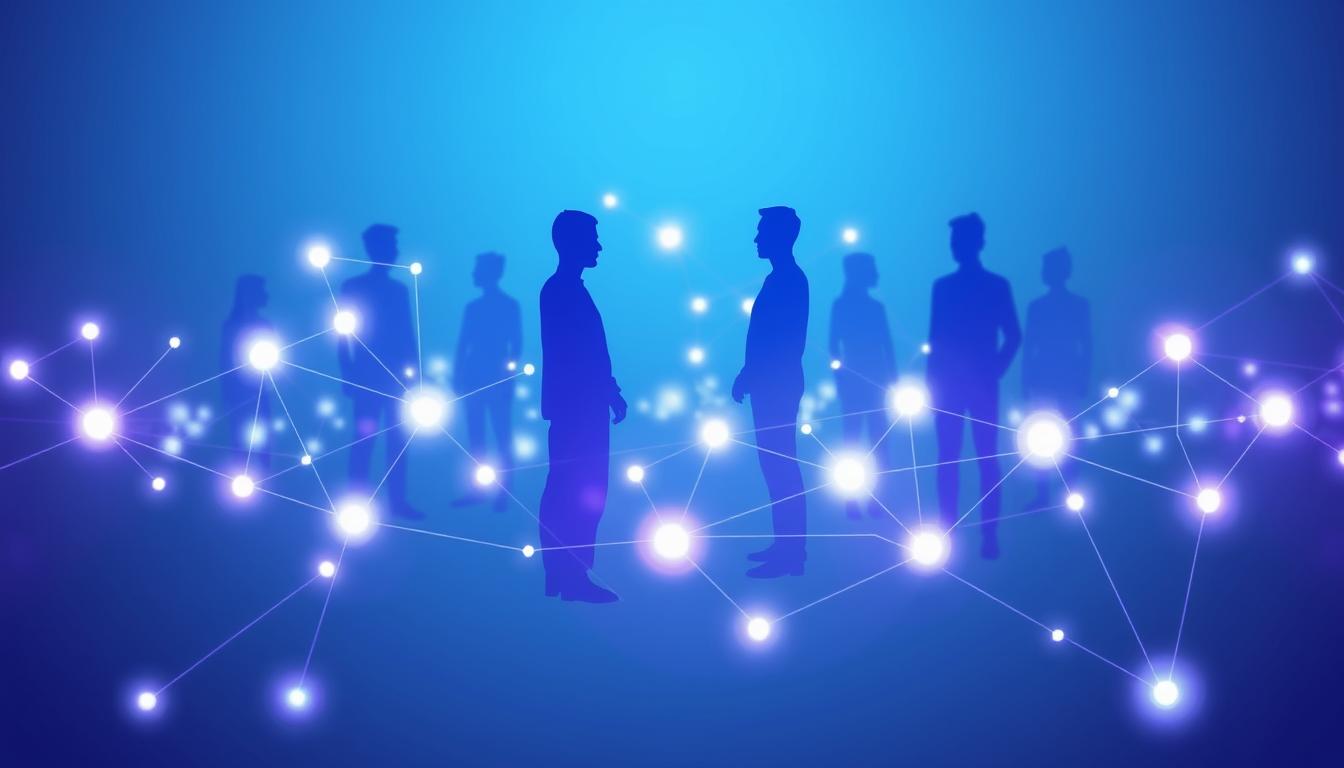
Coined by Thomas Malone, founding director of the MIT Center for Collective Intelligence, Superminds represent groups of humans and computers working together toward shared goals. Unlike traditional teams or standalone AI systems, Superminds leverage the unique strengths of both human intuition and machine processing power.
As Malone explains in his groundbreaking research, “Almost all human achievements in business, government, science, and beyond have come from groups of people working together in superminds—like hierarchies, markets, democracies, and communities.” Now, these collectively intelligent human groups are about to get much smarter through their collaboration with AI.
💡 “The smartest organizations aren’t those with the smartest individuals—they’re those that think together.”
Consider Wikipedia as an early example of a Supermind. Thousands of contributors, supported by algorithms that help manage content, have created the world’s largest encyclopedia—something no individual or traditional organization could accomplish. Now imagine this same principle applied to your organization’s strategic planning process.
The Five Cognitive Processes of Superminds
What makes Superminds so powerful is their ability to enhance five fundamental cognitive processes that drive organizational intelligence:
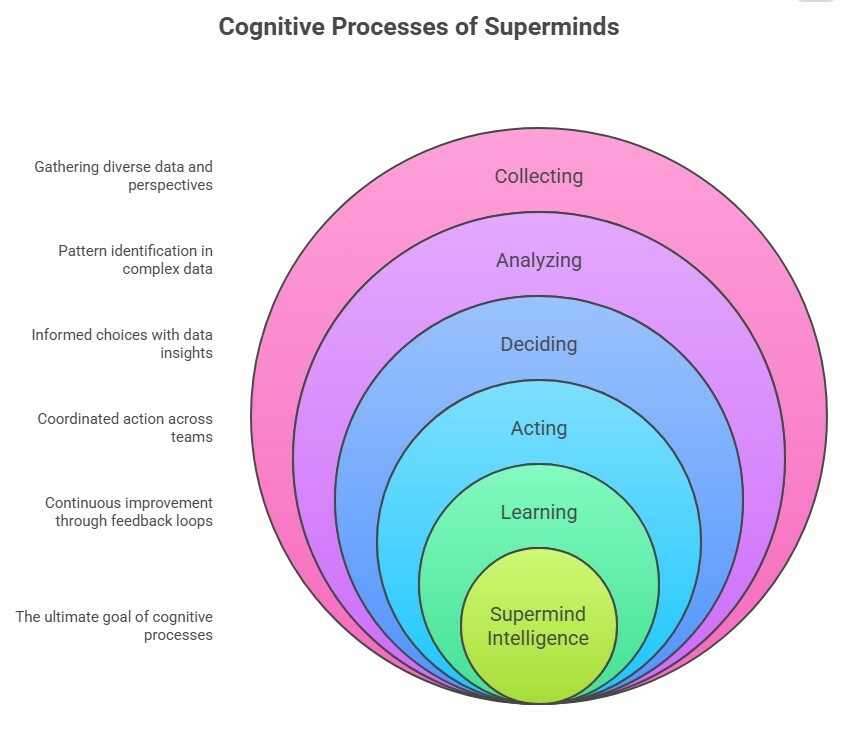
🧠 Collecting
Superminds excel at gathering diverse data and perspectives through AI-powered collaboration tools. While humans contribute creative insights and contextual understanding, AI systems can continuously monitor vast information landscapes, ensuring nothing important is missed.
💡 Analyzing
Machine learning algorithms can identify patterns in complex data that humans might overlook, while people excel at interpreting these findings within broader contexts. Together, they create a more comprehensive analytical capability than either could achieve alone.
✅ Deciding
Group decision-making enhanced by predictive algorithms combines the wisdom of crowds with data-driven insights. This hybrid approach helps organizations make better choices by balancing human judgment with computational precision.
🚀 Acting
Digital platforms enable coordinated collective action across global teams. AI systems can help orchestrate complex workflows, ensuring the right people are involved at the right time while maintaining alignment with strategic objectives.
🔁 Learning
Continuous improvement through human-machine feedback loops allows organizations to adapt quickly. AI systems can track outcomes and suggest adjustments, while humans provide the creative thinking needed to reimagine approaches entirely.
💪 Combined Power
When these five processes work together in a Supermind, they create an organizational intelligence greater than the sum of its parts—one that can tackle complex challenges with unprecedented effectiveness.
Superminds in Corporate Strategic Planning
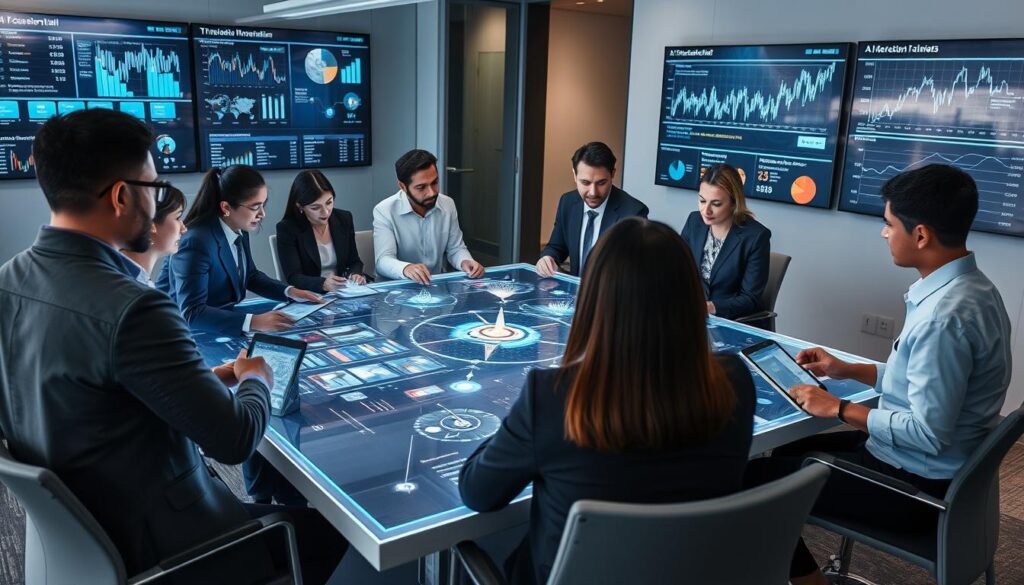
Superminds are transforming how organizations approach strategic planning. Traditional approaches often suffer from limited perspectives, confirmation bias, and inability to process vast amounts of data. By contrast, Superminds enable:
Enhanced Strategic Foresight
AI-powered simulation tools can generate and test thousands of future scenarios, while human strategists evaluate which ones deserve deeper consideration. This combination helps organizations anticipate market changes and prepare for multiple futures rather than betting on a single prediction.
Collective Scenario Planning
Digital platforms allow diverse stakeholders—from frontline employees to external experts—to contribute to scenario development. AI systems can then identify patterns across these inputs, highlighting blind spots and opportunities that might otherwise be missed.
Data-Driven Decision Alignment
Prediction markets and other collective forecasting tools help quantify uncertainty and align leadership decisions with the organization’s collective intelligence. These tools surface disagreements early and create a shared understanding of strategic challenges.
Dynamic Strategy Adaptation
Rather than treating strategy as a static annual exercise, Superminds enable continuous refinement based on real-time feedback. AI systems can monitor key indicators while humans interpret their significance, allowing strategies to evolve as conditions change.
Superminds are the new boardrooms—where data meets intuition and collective wisdom emerges from the integration of human and machine intelligence.
The Role of AI in Superminds
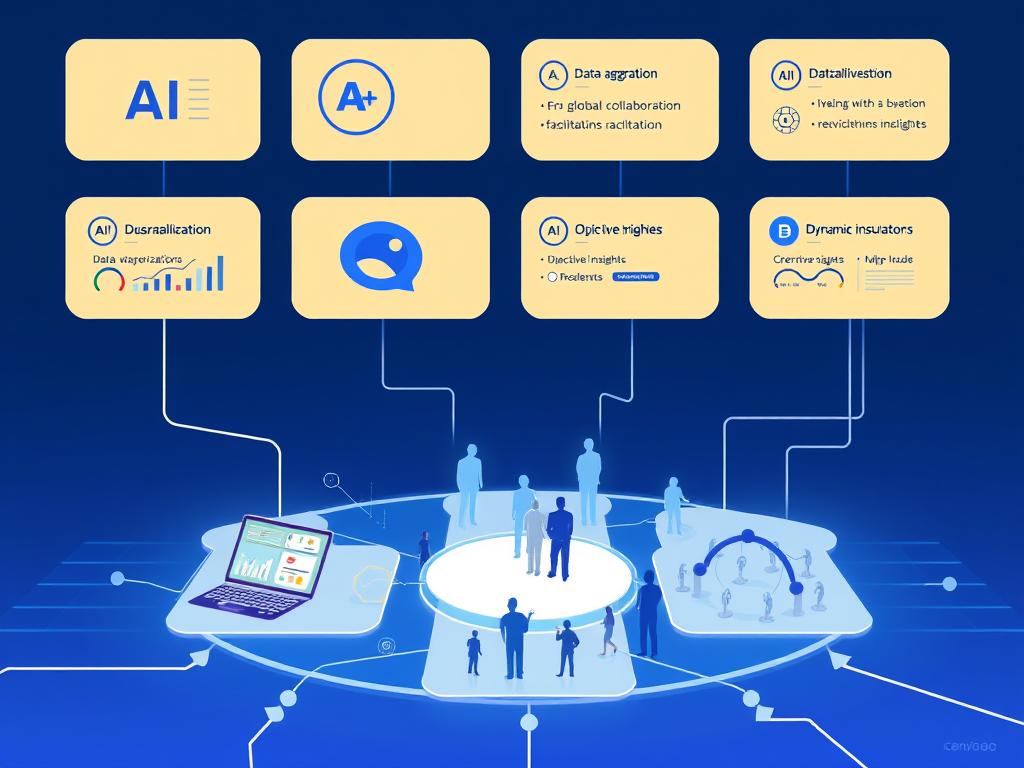
Computers add unique value to Superminds in ways that complement rather than replace human contributions:
These capabilities are being realized through tools like collective forecasting platforms, AI co-pilots for strategy, and knowledge-sharing communities that combine human expertise with machine intelligence.
Key insight: The most effective Superminds don’t just add AI to existing processes—they reimagine how work happens when human and machine intelligence are integrated from the ground up.
Real-World Examples of Superminds in Action
Strategic Opportunity Identification
A global consumer goods company deployed an AI-powered platform that allowed employees across 60 countries to contribute ideas for new products. The AI system categorized submissions, identified patterns, and highlighted promising concepts based on market data. This Supermind approach generated 37% more viable product concepts than their traditional R&D process.
Corporate Forecasting
A technology firm integrated prediction markets with machine learning to forecast quarterly sales. Employees could “bet” on outcomes while the AI system analyzed historical patterns. The combined approach reduced forecast error by 31% compared to traditional methods, enabling more accurate resource allocation and planning.
Evidence-Based Meetings
A healthcare organization transformed their strategic planning meetings by implementing an AI system that provided real-time data visualization and analysis during discussions. This shifted conversations from opinion-driven debates to evidence-based decisions, reducing meeting time by 40% while improving implementation success rates.
These examples demonstrate how Superminds can transform strategic planning from an occasional, limited exercise into a continuous, inclusive process that leverages both human creativity and machine intelligence.
Challenges & Best Practices
Best Practices
Common Challenges
Organizations that successfully implement Superminds recognize that the goal isn’t to replace human decision-makers but to augment their capabilities. They create cultures where people and machines continuously learn from each other, with each contributing their unique strengths to the collective intelligence.
Discover the Full Potential of Superminds
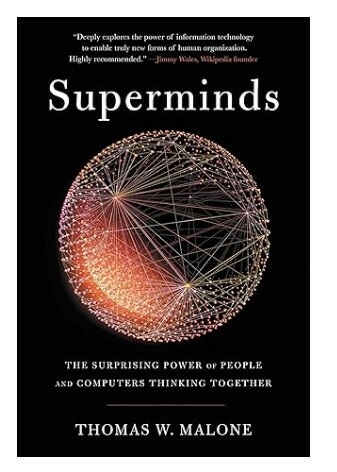
In his groundbreaking book “Superminds,” MIT professor Thomas W. Malone provides a comprehensive framework for understanding and implementing collective intelligence enhanced by technology. Discover how your organization can harness the power of people and computers thinking together to solve complex problems and create new opportunities.
“Deeply explores the power of information technology to enable truly new forms of human organization. Highly recommended.”
Implementation Checklist: Building Your Organization’s Supermind
Pro Tip: Start with a specific strategic challenge where better information processing and diverse perspectives would clearly add value. Use this as a pilot to demonstrate the potential of the Supermind approach before scaling to broader applications.
The Future of Strategic Intelligence
The future of strategy isn’t built by individuals—it’s co-created by Superminds, where the center of collective intelligence thrives. This evolution emphasizes that success in the modern landscape requires more than just individual brilliance; it necessitates a collaborative approach that harnesses the strengths of diverse teams. The organizations that learn to think together, human and machine, will lead the next era of intelligent transformation. As computational power continues to grow and collaborative technologies evolve, the potential of Superminds, driven by groups of people and artificial intelligence, will only increase. This integration of human insight with machine efficiency allows for innovative solutions that can adapt to complex challenges in real-time, ensuring that organizations remain agile and competitive.
Is your organization thinking collectively—or still thinking alone? The answer to this question may determine your competitive position in the years ahead.
By understanding and implementing the principles of Superminds, you can begin to harness the extraordinary potential that emerges when people and groups work together toward shared business goals. This collective effort not only enhances problem-solving capabilities but also fosters a culture of innovation, where ideas can flourish through the synergy of diverse perspectives.