
What Is the Executive Learning Cycle?
The Executive Learning Cycle is a structured approach that transforms leadership experiences into actionable wisdom. Think of it as a feedback loop that converts raw experiences into refined leadership capabilities. Based on David Kolb’s experiential learning theory, this cycle has been adapted specifically for executive development to address the unique challenges leaders face in today’s complex business environment.
Unlike passive learning methods, the Executive Learning Cycle is active and intentional. It’s not about simply accumulating experiences—it’s about extracting meaningful insights from those experiences and applying them to future situations. This cycle creates a continuous improvement loop that builds leadership muscle over time.
Why the Executive Learning Cycle Matters for Leaders
In today’s fast-paced business environment, leaders face unprecedented complexity and change. The Executive Learning Cycle provides a framework to navigate this complexity by turning every challenge into a growth opportunity. Here’s why it matters:
Enhanced Decision-Making
By systematically reflecting on past decisions, you identify patterns and principles that improve future choices. This structured approach helps you avoid repeating mistakes and builds confidence in your decision-making process.
Increased Leadership Agility
The cycle develops your ability to adapt quickly to changing circumstances. Leaders who master this process can pivot strategies more effectively when faced with unexpected challenges or opportunities.
Deeper Self-Awareness
Regular reflection builds emotional intelligence by helping you understand your reactions, biases, and leadership patterns. This awareness is fundamental to authentic leadership.
Accelerated Growth
Without structured reflection, growth happens randomly and slowly. The Executive Learning Cycle accelerates development by intentionally extracting lessons from every experience.
“Leadership is not about never making mistakes—it’s about never wasting them.”
The Four Key Stages of the Executive Learning Cycle
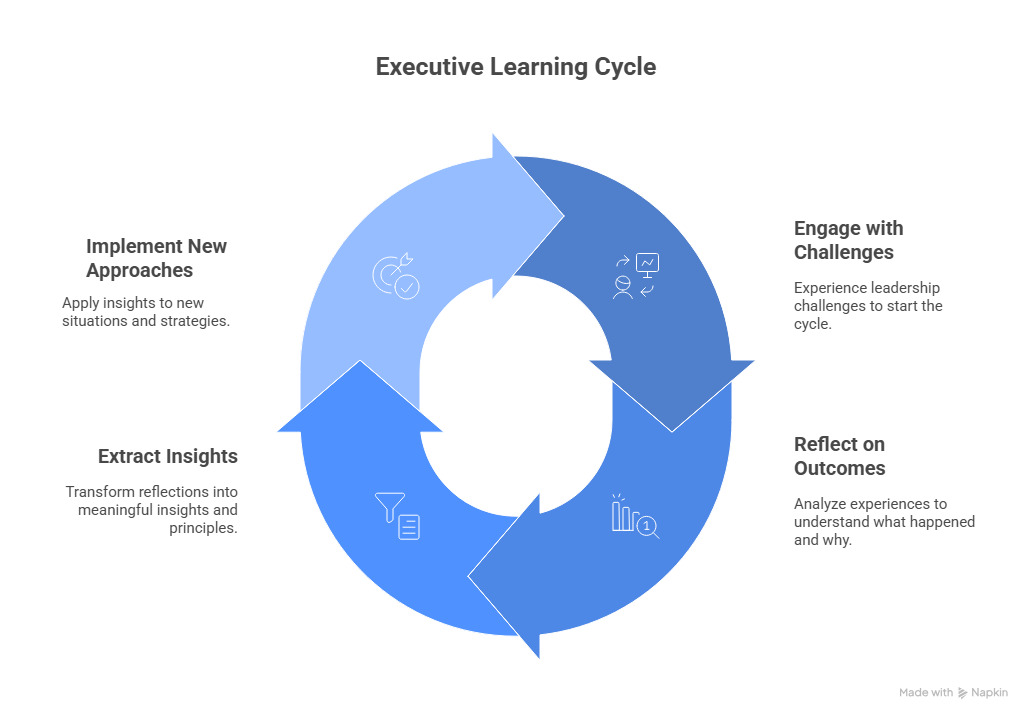
The Executive Learning Cycle consists of four interconnected stages that create a continuous loop of growth and development. Each stage builds upon the previous one, creating a powerful framework for transforming experiences into wisdom.
🌀 Experience: Engaging with Leadership Challenges
The cycle begins with concrete experiences—the daily challenges, decisions, and interactions that make up your leadership journey. These experiences provide the raw material for learning and growth. The key is to approach each experience with curiosity and openness, recognizing its potential for development.
Key activities:
- Taking on new responsibilities or challenges
- Making important decisions
- Leading teams through change
- Navigating difficult conversations
🧠 Reflection: Analyzing Outcomes and Processes
Reflection is the bridge between experience and learning. This stage involves stepping back to analyze what happened, why it happened, and what it means. Effective reflection requires honesty, objectivity, and a willingness to examine both successes and failures.
Key questions:
- What exactly happened? (Describe objectively)
- What went well and what didn’t?
- What was surprising or unexpected?
- What emotions did I experience, and why?
🚀 Learning: Extracting Insights and Principles
In this stage, you transform reflections into meaningful insights and principles. This involves identifying patterns, making connections to existing knowledge, and formulating new mental models that can guide future actions.
Key activities:
- Identifying patterns across multiple experiences
- Connecting observations to leadership theories
- Developing personal leadership principles
- Consulting with mentors to gain perspective
✅ Application: Implementing New Approaches
The final stage involves applying your insights to new situations. This is where learning becomes actionable and creates value. Application closes the loop and generates new experiences, starting the cycle again.
Key activities:
- Testing new approaches in real situations
- Adjusting strategies based on insights
- Sharing lessons with your team
- Creating systems to reinforce new behaviors
Step-by-Step Guide to Applying the Executive Learning Cycle
Implementing the Executive Learning Cycle requires intentionality and structure. Here’s a practical guide to help you integrate this powerful approach into your leadership practice:
1. Create a Reflection Routine
- Schedule 15-30 minutes weekly for structured reflection
- Use a dedicated leadership journal to capture insights
- Create a distraction-free environment for deep thinking
- Consider both recent events and longer-term patterns
2. Ask Powerful Questions
- What specific leadership challenges did I face?
- What was my impact on others and outcomes?
- What assumptions influenced my decisions?
- What would I do differently next time?
3. Seek Multiple Perspectives
- Conduct after-action reviews with your team
- Request feedback from trusted colleagues
- Consult with a mentor or executive coach
- Consider how others might view the situation
4. Extract Key Learnings
- Identify recurring themes across experiences
- Distinguish between situational factors and patterns
- Connect insights to leadership principles
- Summarize learnings in simple, actionable statements
5. Create Action Plans
- Develop specific strategies to apply insights
- Set measurable goals for behavior change
- Identify opportunities to test new approaches
- Create accountability mechanisms
6. Monitor and Adjust
- Track the results of new approaches
- Gather feedback on implementation
- Refine strategies based on outcomes
- Celebrate progress and learning
Real-Life Examples of the Executive Learning Cycle in Action
Case Study: Transforming Team Communication
Sarah, a newly appointed Chief Operating Officer, noticed that her executive team meetings weren’t producing the strategic insights needed. Using the Executive Learning Cycle, she approached the problem methodically:
Experience: She observed three consecutive team meetings, noting participation patterns, decision quality, and energy levels.
Reflection: In her leadership journal, Sarah analyzed what she observed. She realized that she was dominating conversations and team members were hesitant to challenge ideas.
Learning: Sarah recognized that her directive leadership style, which had served her well in crisis situations, was stifling innovation in strategic discussions. She needed to create psychological safety and practice more inquiry.
Application: She restructured meetings to begin with open questions, implemented a round-robin format for key decisions, and explicitly invited constructive dissent. Within two months, meeting effectiveness scores increased by 40%, and the team generated three breakthrough strategic initiatives.
Organizational Application: Innovation Acceleration
A global technology company implemented the Executive Learning Cycle as part of their innovation process. After each product launch, cross-functional teams would:
Experience: Document the entire product development journey from concept to market.
Reflection: Conduct structured debriefs examining successes, failures, and unexpected outcomes.
Learning: Identify patterns and principles that could improve future innovation processes.
Application: Update their innovation playbook and implement specific changes to their development methodology.
This systematic approach reduced time-to-market by 35% and increased successful product launches by 28% over a two-year period. More importantly, it created an organizational culture where learning from experience became embedded in their operating model.
Common Mistakes to Avoid in the Executive Learning Cycle
Best Practices
- Schedule regular reflection time as a non-negotiable priority
- Seek diverse perspectives to challenge your assumptions
- Document insights systematically for future reference
- Create specific action plans to apply learnings
- Measure the impact of applied insights
Common Pitfalls
- Treating reflection as optional when busy
- Focusing only on successes while avoiding failures
- Gathering insights without creating action plans
- Reflecting in isolation without external feedback
- Rushing through the process without depth
Reflection Tip: The quality of your questions determines the quality of your insights. Move beyond “What happened?” to “Why did it happen?” and “What does this reveal about my leadership patterns?”
Tools, Books & Resources to Master the Executive Learning Cycle
Accelerate your leadership development with these carefully selected resources that will help you implement the Executive Learning Cycle effectively:
Learning to Lead: A Workbook on Becoming a Leader
Price: $24.99
This comprehensive guide provides a detailed framework for implementing the Executive Learning Cycle in your leadership practice. Includes practical worksheets, case studies, and reflection.
Review highlight: “Transformed how I approach leadership challenges. The structured reflection tools alone are worth the price.”
The Reflective Leader
Price: $19.95
Discover how top executives use structured reflection to make better decisions and avoid costly mistakes. Features interviews with 25 CEOs and their reflection practices.
Review highlight: “Finally, a practical approach to reflection that busy executives can actually implement.”
The Cycle of Leadership: How Great Leaders Teach Their Companies to Win
Price: $12.99
In The Leadership Engine, Noel Tichy showed how great companies strive to create leaders at all levels of the organization, and how those leaders actively develop future generations of leaders.
| Resource | Format | Price | Focus Area | Best For |
| Learning to Lead | Hardcover/Kindle | $24.99 | Comprehensive Framework | New Executives |
| The Reflective Leader | Paperback/Kindle | $19.95 | Case Studies | Experienced Leaders |
| The Cycle of Leadership | Paperback/Kindle | $12.99 | Practical Application | New Executives |
All Books Available on Kindle
Get instant access to these transformative resources on your device.
Executive Learning Cycle Implementation Checklist
Your Path to Leadership Growth
Use this checklist to implement the Executive Learning Cycle in your leadership practice:
- Experience → Reflect → Learn → Apply → RepeatFollow the complete cycle for every significant leadership challenge.
- Schedule weekly reflection timeBlock 30 minutes in your calendar for structured reflection.
- Maintain a leadership journalDocument experiences, reflections, and insights systematically.
- Seek diverse perspectivesEngage mentors, peers, and team members for feedback.
- Create specific action plansTranslate insights into concrete behavior changes.
- Measure your progressTrack how applied insights impact your leadership effectiveness.
- Share your learning journeyModel the process for your team to create a learning culture.
Conclusion: Transform Your Leadership Through the Executive Learning Cycle
Every leadership challenge is a classroom if you choose to learn from it. The Executive Learning Cycle provides a structured approach to extract wisdom from your experiences and apply it to future situations. By embracing this cycle—experiencing, reflecting, learning, and applying—you won’t just face challenges; you’ll grow stronger from them.
Leadership excellence isn’t about avoiding mistakes; it’s about never wasting them. Start implementing the Executive Learning Cycle today, and watch as your leadership effectiveness transforms one reflection at a time.