


Why do some teams move fast while others drown in meetings? What happens when leaders don’t know which decision-making style to use? And how much risk could your organization avoid simply by clarifying who decides what?
Great decisions are designed, not improvised. As a leader, your ability to make clear, timely decisions directly impacts your team’s success. Yet many organizations lack structured approaches to decision-making, leading to confusion, conflict, and missed opportunities.
This guide will equip you with practical decision-making strategies that modern leaders use to create alignment, reduce risk, and drive results—even in complex, fast-changing environments.
Types of Decision-Making Styles for Leaders
Understanding different decision-making styles is the foundation for choosing the right approach in any situation. Each style has specific benefits and limitations that make it suitable for different scenarios.
🧠 Autocratic Decision-Making
In autocratic decision-making, a single leader makes decisions without consulting others. While this approach has fallen out of favor in many modern organizations, it remains valuable in specific contexts.
When to Use
- Crisis situations requiring immediate action
- Routine decisions with established protocols
- When you have unique expertise others lack
- Confidential matters with limited information sharing
When to Avoid
- Complex problems requiring diverse perspectives
- When team buy-in is critical for implementation
- Decisions that impact team culture or morale
- When you lack sufficient information or expertise
👥 Participatory Decision-Making
Participatory decision-making involves gathering input from team members while retaining final decision authority. This balanced approach is often the default style for effective leaders.
When to Use
- When you need specialized knowledge from team members
- Decisions affecting multiple departments or functions
- When implementation requires team commitment
- Developing team members’ decision-making skills
When to Avoid
- Emergencies requiring immediate action
- When team input would create unnecessary conflict
- Routine decisions where consultation adds no value
- When the decision outcome is predetermined
🤝 Consensus-Based Decision-Making
Consensus-based decision-making requires the group to reach a solution everyone can support. This approach prioritizes alignment and shared ownership.
When to Use
- High-impact decisions affecting many stakeholders
- Situations where buy-in is critical for execution
- Complex, ambiguous problems needing diverse expertise
- Sensitive issues (culture, ethics, long-term strategy)
When to Avoid
- Time-sensitive decisions
- When team dynamics are already strained
- Low-stakes operational choices
- When data clearly points to one answer
📊 Data-Driven Decision-Making
Data-driven decision-making relies primarily on metrics, evidence, and analytical models rather than intuition or opinion. This approach minimizes bias and increases objectivity.
When to Use
- Decisions with measurable outcomes
- When historical data is relevant and available
- Resource allocation and prioritization
- Performance evaluation and improvement
When to Avoid
- Novel situations with no historical precedent
- When available data is incomplete or unreliable
- Decisions heavily influenced by human factors
- When ethical considerations outweigh efficiency
Benefits of Participatory Decision-Making
While each decision-making style has its place, participatory approaches offer unique advantages that make them particularly valuable for modern leaders. Research consistently shows that involving team members in decisions leads to better outcomes and stronger organizations.
Higher Commitment and Ownership
When people participate in making decisions, they develop a sense of ownership that drives implementation. A study by Harvard Business Review found that decisions with stakeholder input were executed with 65% more fidelity than those made unilaterally.
As one manufacturing team leader shared: “When we shifted from top-down decisions to involving line operators in process improvements, implementation time dropped from weeks to days because people were invested in making their own ideas work.”
Better Innovation and Diversity of Thought
Teams that leverage diverse perspectives consistently outperform homogeneous thinking. McKinsey research shows that companies with diverse leadership teams are 33% more likely to outperform their competitors in profitability.
Participatory decision-making creates space for different viewpoints, experiences, and expertise to shape solutions, leading to more innovative and comprehensive approaches.
Stronger Trust and Psychological Safety
When leaders invite input, they signal respect for team members’ expertise and judgment. This builds psychological safety—the belief that one can speak up without fear of negative consequences.
Google’s Project Aristotle identified psychological safety as the most important factor in high-performing teams. Participatory decision-making directly contributes to this foundation of team effectiveness.
Fewer Blind Spots in Execution
Leaders who make decisions in isolation often miss critical implementation challenges that frontline team members could easily identify. Participatory approaches surface potential obstacles early, when they’re easier to address.
A healthcare organization avoided a costly electronic records system failure by involving nurses in the selection process. Their practical insights identified usability issues that executives had overlooked.
When to Use Consensus-Based Decision Making

Consensus-based decision-making is powerful but resource-intensive. Understanding when to employ this approach—and when to avoid it—is crucial for effective leadership.
🤝 Ideal Use Cases for Consensus
High-Impact Decisions Affecting Many Stakeholders
When decisions will significantly impact multiple teams or departments, consensus builds the broad support needed for successful implementation. Examples include organizational restructuring, major technology changes, or shifts in strategic direction.
⚖️ Situations Where Buy-in is Critical for Execution
Some decisions require enthusiastic implementation rather than mere compliance. When success depends on discretionary effort and creative problem-solving during execution, consensus creates the commitment needed to overcome obstacles.
🧩 Complex, Ambiguous Problems Needing Diverse Expertise
When no single person has all the knowledge needed to make an optimal decision, consensus processes integrate multiple perspectives into a more comprehensive solution. This is particularly valuable for novel challenges without clear precedents.
🔐 Sensitive Issues (Culture, Ethics, Long-term Strategy)
Decisions that touch on values, identity, or long-term commitments benefit from consensus approaches that ensure alignment with organizational principles and stakeholder expectations.
When NOT to Use Consensus
- Urgent decisions requiring immediate action
- Low-stakes operational choices where the impact is minimal
- Technical decisions where expertise should outweigh opinion
- When team dynamics are unhealthy or power imbalances would distort the process
- When clear accountability for outcomes is essential
“Consensus is about finding the highest common denominator, not the lowest. It’s not about everyone getting exactly what they want, but creating a solution everyone can actively support.”
Components of a RACI Matrix for Clear Decision Roles
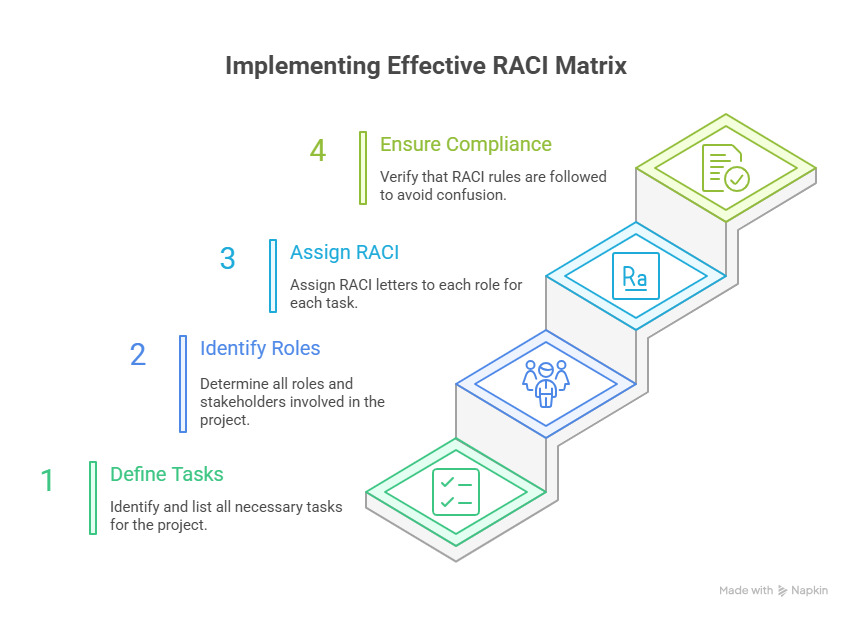
One of the biggest sources of decision-making friction is role confusion. The RACI matrix is a powerful tool that clarifies who should be involved in decisions and in what capacity. This clarity accelerates decision-making while ensuring appropriate input.
| Role | Definition | Responsibilities | Example |
| R – Responsible | Does the work to complete the task | Gathers information, analyzes options, implements the decision | Project manager researching vendor options |
| A – Accountable | Owns the outcome and makes final decisions | Approves work, holds ultimate authority, answers for results | Department head approving budget allocation |
| C – Consulted | Provides input before decision | Offers expertise, perspective, and recommendations | IT security reviewing system requirements |
| I – Informed | Not involved but must be updated | Receives communication about decisions and progress | Adjacent teams affected by the change |
How RACI Improves Decision-Making
- Eliminates ambiguity about who makes the final call
- Prevents decision paralysis by clarifying roles upfront
- Ensures the right people provide input at the right time
- Reduces meeting overload by involving only necessary participants
- Creates accountability for both decisions and implementation
RACI Success Story
A logistics company was struggling with slow decision-making around route optimization. By implementing a RACI matrix, they clarified that regional managers were Accountable for decisions, analysts were Responsible for data preparation, drivers were Consulted for practical insights, and the executive team was simply Informed of outcomes. This clarity reduced decision time from weeks to days while improving the quality of routing decisions.
How to Reduce Decision-Making Risk

Even with the right decision-making style and clear roles, leaders must actively manage risk. These practical strategies help reduce uncertainty and increase confidence in your decisions.
Scenario Planning and Pre-mortem Analysis
Rather than assuming a single future, scenario planning explores multiple possible outcomes. This broadens thinking and identifies potential challenges before they arise.
The pre-mortem technique takes this further by assuming your decision has failed and working backward to identify what went wrong. This counterintuitive approach helps teams spot risks they might otherwise miss.
Data Validation and Evidence Checks
Decision quality depends on information quality. Implement systematic validation by:
- Verifying data sources and collection methods
- Testing assumptions with contrary evidence
- Distinguishing facts from interpretations
- Seeking independent verification of critical information
Expert Consultation to Reduce Assumptions
When decisions venture into unfamiliar territory, external expertise becomes invaluable. Identify knowledge gaps and systematically fill them through:
- Subject matter expert interviews
- Cross-functional input sessions
- Customer or stakeholder feedback
- Industry benchmark comparisons
Pilot Testing Before Scaling
When possible, test decisions on a small scale before full implementation. This creates learning opportunities with limited downside. Effective pilots:
- Test critical assumptions in real conditions
- Generate data for refining the approach
- Build confidence through demonstrated success
- Identify implementation challenges early
“In a world of uncertainty, the goal isn’t perfect decisions but robust ones—those that perform reasonably well across a range of possible futures.”
Risk Reduction Case Study
A healthcare technology company needed to decide whether to develop a new patient management platform. Instead of making a yes/no decision based on market research alone, they:
- Ran a pre-mortem analysis identifying potential failure points
- Created a prototype to test with a small group of clinics
- Established clear success metrics before beginning the pilot
- Gathered data over three months before committing to full development
This structured approach revealed integration challenges they hadn’t anticipated and allowed them to adjust their design before making a major investment.
Implementing a Complete Decision-Making Cycle
A great decision cycle is like a flight route—you take off, track your progress, and correct your course until you arrive safely. This structured approach ensures consistency and quality across all your decisions.
1️⃣ Define the Problem and Objective
Clearly articulate what needs to be decided and why it matters. Frame the decision in terms of the specific outcomes you want to achieve. This critical first step prevents solving the wrong problem.
Key question: “What specific outcome are we trying to achieve?”
2️⃣ Gather Relevant Information
Collect the data, context, and perspectives needed to make an informed choice. Be systematic about identifying information gaps and filling them.
Key question: “What do we know, and what do we need to learn?”
3️⃣ Choose the Appropriate Decision-Making Style
Based on the nature of the decision, select whether an autocratic, participatory, consensus, or data-driven approach is most appropriate. Consider time constraints, expertise requirements, and implementation needs.
Key question: “Who needs to be involved and how?”
4️⃣ Generate and Compare Options
Develop multiple potential solutions rather than fixating on a single approach. Evaluate each against consistent criteria to enable objective comparison.
Key question: “What are all possible paths, and how do they compare?”
5️⃣ Evaluate Risks and Impacts
Assess potential consequences, both intended and unintended. Consider impacts across different time horizons and stakeholder groups.
Key question: “What could go wrong, and who will be affected?”
6️⃣ Make the Decision
Choose the option that best achieves your objectives while managing risks appropriately. Document the rationale to create accountability and enable future learning.
Key question: “Which option best balances our goals and constraints?”
7️⃣ Communicate Clearly to All Stakeholders
Share not just what was decided, but why and how it will be implemented. Tailor communication to different audiences based on their involvement and concerns.
Key question: “How can we ensure understanding and support?”
8️⃣ Execute and Monitor
Implement the decision with clear ownership and timelines. Track progress against defined success metrics to identify any need for course correction.
Key question: “Is implementation proceeding as planned?”
9️⃣ Review Outcomes and Adjust
After implementation, evaluate results against original objectives. Capture lessons learned to improve future decision processes.
Key question: “What worked, what didn’t, and what can we learn?”
Decision Cycle in Action
A cross-functional tech team used this structured cycle to redesign a failing customer onboarding process. By clearly defining success metrics upfront and systematically evaluating multiple redesign options, they reduced onboarding time by 65% while improving customer satisfaction scores.
Common Decision-Making Mistakes to Avoid
Even with the best frameworks, leaders can fall into common traps that undermine decision quality. Awareness of these pitfalls is the first step to avoiding them.
🚫 Making Decisions Without Clear Ownership
When accountability is diffused, decisions often stall or lack follow-through. Always establish who is ultimately responsible for the decision and its implementation.
🚫 Confusing Collaboration with Consensus
Seeking input doesn’t mean everyone must agree. Many leaders waste time pursuing unanimous support when alignment on implementation is what truly matters.
🚫 Letting Meetings Drag On Without Structure
Decision meetings need clear agendas, facilitation, and time boundaries. Without structure, they become discussion forums rather than decision engines.
🚫 Ignoring Risk Signals or Expert Input
Confirmation bias leads us to discount information that contradicts our preferred course of action. Actively seek and seriously consider dissenting views and warning signs.
🚫 Skipping the Evaluation Phase After Execution
Without systematic review of outcomes, organizations miss critical learning opportunities and repeat the same mistakes across multiple decisions.
Decision-Making Best Practices Checklist
Use this checklist to evaluate and improve your decision-making processes:
- Choose the right decision style based on the situation’s urgency, complexity, and implementation needs
- Use participatory methods to increase buy-in and leverage diverse perspectives
- Apply consensus approaches only when broad support is truly necessary
- Build clarity with RACI to establish clear roles and accountability
- Reduce risk with structured tools like pre-mortems and pilot testing
- Follow the complete decision cycle from problem definition through outcome review
- Document decisions including rationale, alternatives considered, and expected outcomes
- Communicate effectively to all stakeholders affected by the decision
- Evaluate results against original objectives to capture learning
- Build organizational decision capability by sharing best practices across teams
Becoming a More Effective Decision-Making Leader
Great leaders aren’t defined by perfect decisions—but by the systems they use to make them. When your decision-making becomes intentional, structured, and collaborative, your team becomes unstoppable.
By applying the frameworks in this guide, you can transform how your organization approaches decisions at every level. Start by selecting one area to focus on this week—whether it’s clarifying decision roles with RACI, implementing pre-mortem risk analysis, or improving your decision communication.
What decision-making style can you upgrade this week?