
What if you could design an AI product with the same framework used by top innovators at MIT? 🤔 The rapidly evolving landscape of artificial intelligence demands not just technical knowledge, but a structured approach to transform ideas into impactful solutions. The MIT xPRO AI Design Framework offers exactly that—a comprehensive methodology that guides professionals through the complex journey of AI product development.
This framework, developed by leading minds at MIT, empowers product managers, technologists, and business leaders to create AI solutions that are not only technically sound but also ethically responsible and business-aligned. Let’s explore how this powerful framework can help you navigate the AI product development lifecycle with confidence and precision.
The MIT xPRO AI Design Framework: A Comprehensive Overview
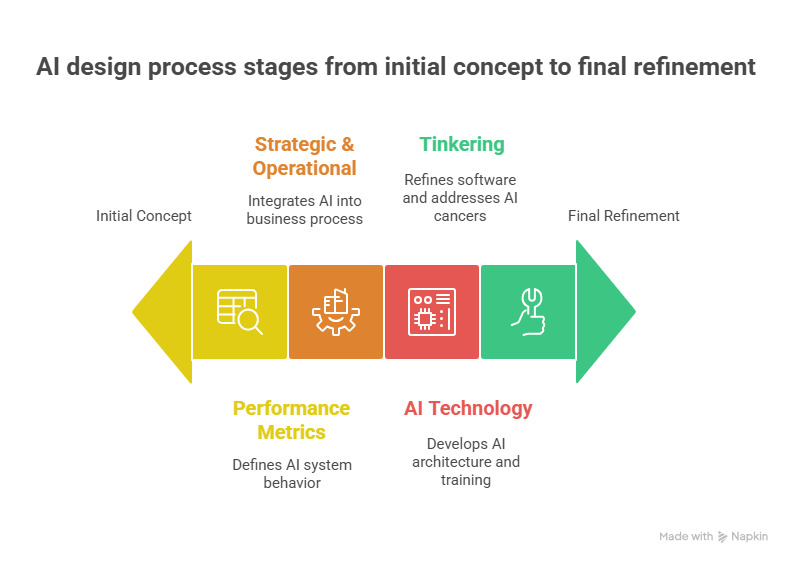
The MIT xPRO framework stands out for its balanced integration of technical expertise and business strategy. Unlike approaches that focus solely on algorithms or business cases in isolation, this framework weaves together four essential stages that guide you from initial concept to market-ready AI product. 🧠
Each stage builds upon the previous one, creating a cohesive development process that addresses both the technical challenges and business realities of bringing AI solutions to market. Let’s examine each stage in detail.
Stage I – Defining the Behavior and Scope
The journey begins by clearly articulating what your AI solution will do and where it will create value. This foundational stage prevents the common pitfall of building technology in search of a problem. 💡
Performance Metrics Approach
This approach focuses on establishing clear, measurable outcomes that your AI solution must achieve. Rather than vague aspirations, you’ll define specific metrics that determine success:
- Accuracy requirements (e.g., 95% prediction accuracy)
- Speed benchmarks (e.g., processing time under 200ms)
- Resource efficiency targets
- User satisfaction metrics
Scope Definition Approach
Here, you’ll precisely define the boundaries of what your AI will and won’t do:
- Specific tasks the AI will perform
- Types of data it will process
- User interactions it will support
- Explicit limitations and constraints
The key question at this stage is: “What human behaviors or decisions can AI replicate or enhance in a way that creates measurable value?”
Real-World Example
Consider medical diagnostics: A traditional approach might involve radiologists spending hours reviewing medical images to identify potential issues. An AI solution using the MIT framework would first define specific behaviors (detecting lung nodules with 98% accuracy) and scope (working with standard CT scan formats, flagging suspicious areas for human review, not making final diagnoses).

Ready to Master Stage I of the AI Design Process?
Learn how to precisely define AI behavior and scope through MIT’s expert-led curriculum.
Stage II – Designing the Business Process
Once you’ve defined what your AI will do, the next stage focuses on how it will integrate into business operations and deliver value. This critical step bridges technical capabilities with real-world application. 🔄
Strategic Approach
This dimension examines whether your AI solution will be:
- Product-Oriented: A standalone AI offering (like a smart assistant)
- Customer Solution-Oriented: An AI capability embedded within existing products or services
- Internal Process-Oriented: AI that enhances organizational efficiency
Operational Approach
This dimension addresses how the AI solution creates network effects and scales:
- Data collection and feedback loops
- Integration points with existing systems
- User adoption pathways
- Scalability considerations
Business Process Integration Example
In logistics, an AI solution might be designed to integrate with existing tracking systems, consuming real-time data from multiple sources to optimize routing decisions. The MIT framework would guide you to define exactly where in the decision chain the AI operates, how it receives inputs, and how its outputs influence subsequent actions.

Did You Know? According to MIT research, AI implementations that carefully design business process integration are 3x more likely to succeed than those focused solely on algorithm performance.
Stage III – Building the AI Technology
With clear behavior definitions and business process designs in place, Stage III focuses on selecting and implementing the right AI technologies. This stage balances technical sophistication with practical constraints. 🤖
Intellectual Property Approach
This dimension addresses the AI models and algorithms that power your solution:
- Selecting appropriate machine learning paradigms
- Determining model architecture
- Balancing accuracy with computational efficiency
- Considering explainability requirements
Data Strategy Approach
This dimension focuses on the lifeblood of AI—data:
- Data acquisition and preparation
- Training/testing/validation splits
- Data governance and privacy considerations
- Ongoing data collection for model improvement
Training Approaches in the MIT Framework
| Learning Type | Best Use Cases | Data Requirements | Implementation Complexity |
| Supervised Learning | Classification, prediction, recommendation | Labeled data sets | Medium |
| Unsupervised Learning | Pattern discovery, clustering, anomaly detection | Unlabeled data | Medium-High |
| Reinforcement Learning | Sequential decision-making, robotics, gaming | Environment feedback | High |
| Transfer Learning | Limited data scenarios, specialized applications | Pre-trained models + domain data | Medium |
Real-World Example
Netflix’s recommendation system exemplifies this stage of the MIT framework. Their technology approach combines collaborative filtering algorithms with content-based models, while their data strategy leverages viewing history, explicit ratings, and implicit signals (like when you stop watching). This combination delivers personalized recommendations that keep viewers engaged.

Master AI Technology Selection and Implementation
Learn directly from MIT faculty how to build effective AI systems aligned with business goals.
Stage IV – Tinkering and Iteration
The final stage of the MIT xPRO AI Design Framework is where theory meets reality. This is where approximately 90% of the real work happens—testing, refining, and continuously improving your AI solution. 🔍
The MIT framework emphasizes that iteration isn’t just debugging—it’s a structured process of addressing specific challenges that emerge when AI meets the real world:
Adversarial Attacks 🧨
Testing how your AI responds to deliberately misleading inputs and strengthening defenses against manipulation.
Bias Mitigation ⚖️
Identifying and addressing unfair patterns in AI decisions that could impact different user groups.
Generalization Challenges 🌐
Ensuring your AI performs well across diverse scenarios beyond its training environment.
Explainability Issues 🔍
Making complex AI decisions understandable to users, stakeholders, and regulators.
Unintended Behaviors 🤖
Discovering and correcting unexpected system responses that emerge in production.
Performance Optimization ⚡
Balancing accuracy with computational efficiency for real-world deployment.
The Iteration Cycle
The MIT framework structures iteration as a continuous cycle:
“In AI product development, the first version is just the beginning. The MIT framework teaches us that systematic iteration—not just technical brilliance—is what separates successful AI products from failures.”
Ethical Considerations in Iteration
The MIT framework places special emphasis on ethical accountability throughout the iteration process. This includes:
- Regular fairness audits across different user demographics
- Privacy impact assessments with each iteration
- Transparency in communicating model limitations
- Governance processes for addressing ethical concerns
Practical Application — From Concept to Corporate Strategy
The true power of the MIT xPRO AI Design Framework emerges when applied to real-world challenges. Let’s examine how organizations can leverage this framework to transform AI from experimental technology to strategic asset. 🚀
Case Study: Healthcare Diagnostic Platform
Consider a healthcare company developing an AI-powered diagnostic platform:
| Framework Stage | Application | Outcome |
| Stage I: Defining Behavior | Specified 97% accuracy in identifying diabetic retinopathy from retinal scans | Clear success metrics established; regulatory pathway identified |
| Stage II: Business Process | Designed integration with existing clinical workflows; defined human-AI collaboration points | Reduced physician review time by 60% while maintaining diagnostic quality |
| Stage III: Technology | Implemented ensemble of CNN models with transfer learning from broader medical imaging datasets | Achieved target accuracy with smaller training dataset than initially estimated |
| Stage IV: Iteration | Conducted bias testing across diverse patient populations; refined model based on physician feedback | Eliminated performance disparities across demographic groups; gained physician trust |

The Role of AI in Corporate Strategic Planning
Beyond individual products, the MIT framework helps organizations develop “superminds”—collaborative systems where humans and AI work together to achieve superior results. These superminds can transform strategic planning by:
Accelerating Decision Cycles
AI can process vast amounts of market data, competitive intelligence, and internal metrics to identify patterns and opportunities that might take human teams weeks to discover.
Enhancing Predictive Accuracy
By combining human intuition with AI’s pattern recognition capabilities, organizations can develop more robust forecasts and scenario plans.
Fostering Innovation
AI can help identify non-obvious connections between market trends, technologies, and customer needs, sparking creative solutions.
Optimizing Resource Allocation
AI-powered simulations can test different resource allocation strategies, helping leaders make more informed investment decisions.

Why Learn the MIT xPRO AI Design Framework?
In today’s rapidly evolving AI landscape, having a structured approach to AI product development isn’t just helpful—it’s essential for success. The MIT xPRO framework offers several distinct advantages: 💡
Structured Process
Gain a repeatable, proven methodology that guides you from initial concept to market-ready AI product, reducing risk and increasing success probability.
Expert Guidance
Learn directly from MIT faculty and industry leaders who have pioneered AI applications across multiple sectors and understand both technical and business challenges.
Immediate Application
Apply the framework to your current projects immediately, whether you’re launching a startup, leading innovation at an enterprise, or consulting on AI strategy.
“The MIT xPRO framework transformed how I approach AI projects. Instead of getting lost in technical details, I now have a clear roadmap that balances innovation with practical implementation.”

From AI Theory to AI Impact
The MIT xPRO AI Design Framework represents more than just a methodology—it’s a bridge between AI’s theoretical potential and practical business impact. By guiding you through the four critical stages of AI product development, it empowers you to create solutions that are technically sound, business-aligned, and ethically responsible. 🚀
As AI continues to transform industries and create new opportunities, professionals who can systematically design and implement AI solutions will be increasingly valuable. The MIT xPRO framework provides exactly the structured approach needed to lead this transformation with confidence and vision.
Ready to move from AI theory to AI impact?
Explore the MIT xPRO Designing and Building AI Products and Services Program and learn how to lead your organization into the future of intelligent innovation.