


Why Change Management Matters
The stakes of poorly managed change are high. According to McKinsey research, organizations that neglect the human side of change face productivity losses of up to 45% during transitions. Employee engagement plummets, turnover increases, and the financial investment in new systems or processes fails to deliver expected returns.
In contrast, companies that excel at change management are 3.5 times more likely to outperform their peers financially. Effective change leadership creates a foundation where transitions become opportunities rather than disruptions. When employees feel prepared, equipped, and supported through change, adoption rates soar, implementation timelines shrink, and the organization realizes benefits faster.
The Cost of Failed Change
- 70% of change initiatives fail to achieve their goals
- Employee productivity drops by 45% during poorly managed transitions
- Failed implementations waste an average of $135 million per $1 billion spent
- Change fatigue leads to increased turnover and disengagement
The Benefits of Effective Change
- 3.5x higher likelihood of outperforming industry peers
- 30% faster implementation timelines
- Increased employee engagement and reduced resistance
- Higher ROI on technology and process investments
Change management isn’t just about avoiding failure—it’s about creating the conditions for transformation to thrive. As Jack Welch famously said: “Change before you have to.” Organizations that proactively build change capability gain a significant competitive advantage in today’s fast-moving business environment.
What Is Change Management? (Explained Simply)
Change management is a structured approach to transitioning individuals, teams, and organizations from a current state to a desired future state. It’s like steering a ship through stormy waters—you need a captain (leadership), a map (strategy), and a crew that trusts the process (engaged employees).
At its core, change management focuses on the people side of change. While project management handles the technical aspects (what needs to change), change management addresses how people will adapt to and adopt the change. This human-centered approach recognizes that successful transformation depends on individual transitions.
🔄 Kotter’s 8-Step Process
Developed by Harvard professor John Kotter, this model emphasizes creating urgency and building coalitions before implementing change.
- Create a sense of urgency
- Build a guiding coalition
- Form strategic vision
- Enlist volunteer army
- Enable action by removing barriers
- Generate short-term wins
- Sustain acceleration
- Institute change
🚀 ADKAR Model
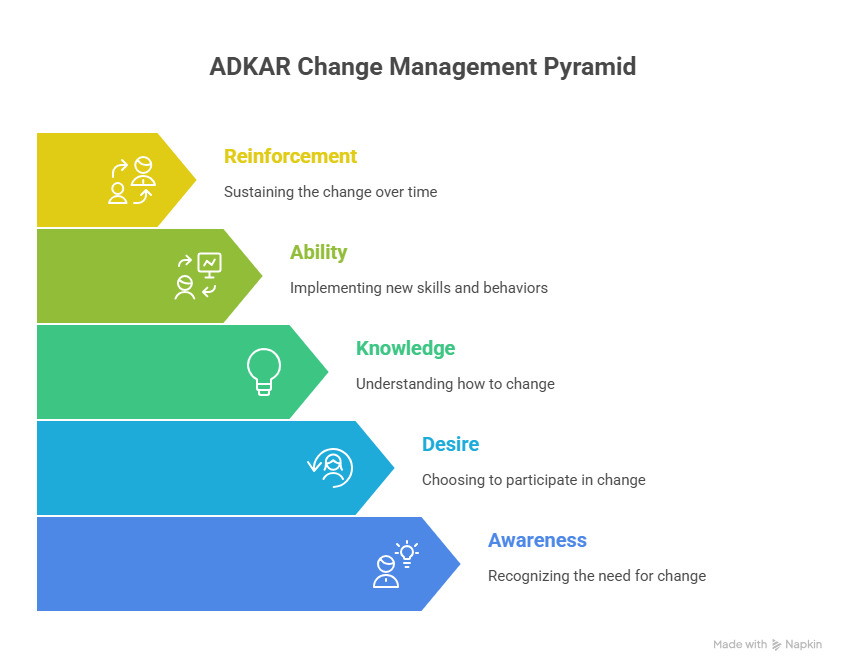
Prosci’s ADKAR model focuses on the individual journey through change, recognizing that organizational change happens one person at a time.
- Awareness of the need for change
- Desire to participate in the change
- Knowledge of how to change
- Ability to implement new skills
- Reinforcement to sustain the change
💡 Lewin’s Model
Kurt Lewin’s simple but powerful model views change as a three-stage process of unfreezing, changing, and refreezing.
- Unfreeze: Create motivation for change by disrupting the status quo
- Change: Implement the desired changes through new behaviors and processes
- Refreeze: Solidify the new state as the standard way of operating
Step-by-Step Guide: How to Lead Change Successfully
Successfully leading change requires a systematic approach that addresses both the strategic and human elements of transformation. Here’s a practical roadmap that combines the best elements from proven frameworks:
✅ Step 1: Define the “Why” — Create a Compelling Case for Change
Before announcing any change initiative, clearly articulate why the change is necessary. Connect the change to organizational goals, market conditions, or customer needs. The more compelling and urgent your case, the easier it will be to gain buy-in.
“People don’t resist change. They resist being changed.”
Key actions:
- Develop a clear, concise statement of why change is necessary
- Gather data that supports the need for change
- Create a vision of what success looks like after the change
- Identify the risks of not changing

✅ Step 2: Build a Change Leadership Team — Identify Champions & Influencers
Change initiatives need champions at every level of the organization. Identify formal and informal leaders who can influence others and involve them early in the process. This coalition will help spread the message and address resistance.
Key actions:
- Map key stakeholders and their potential impact on the change
- Recruit influential leaders from different departments
- Ensure the team represents diverse perspectives
- Equip champions with talking points and resources

✅ Step 3: Communicate Transparently — Keep Messaging Clear, Consistent, and Human
Communication during change should be frequent, honest, and two-way. Address concerns directly, acknowledge challenges, and celebrate progress. Remember that people need to hear messages multiple times and through multiple channels before they fully absorb them.
Key actions:
- Develop a comprehensive communication plan with key messages
- Use multiple channels (meetings, email, intranet, video)
- Create opportunities for questions and feedback
- Address the “What’s in it for me?” for different stakeholder groups

✅ Step 4: Train & Support Employees — Provide Tools, Skills, and Emotional Support
For change to succeed, people need both the capability and the confidence to work in new ways. Invest in training, resources, and support systems that help employees develop necessary skills and navigate the emotional aspects of transition.
Key actions:
- Assess skill gaps and develop targeted training programs
- Create job aids and reference materials
- Establish support channels (help desk, coaches, mentors)
- Acknowledge the emotional journey and provide appropriate support

✅ Step 5: Celebrate Wins & Reinforce Progress — Recognize Milestones to Keep Momentum
Change initiatives can feel overwhelming and endless without visible progress markers. Identify and celebrate short-term wins to build momentum, reinforce the value of the change, and keep energy levels high throughout the process.
Key actions:
- Define clear milestones and success metrics
- Publicly recognize individuals and teams who embrace the change
- Share success stories and positive outcomes
- Use reinforcement mechanisms to prevent backsliding
Real-World Examples of Successful Change Management
Learning from organizations that have successfully navigated major transformations can provide valuable insights for your own change initiatives. Here are two compelling case studies:
Microsoft’s Cultural Transformation Under Satya Nadella
The Challenge: When Satya Nadella became CEO in 2014, Microsoft was losing market relevance with a culture described as competitive, siloed, and resistant to change.
The Approach: Nadella led a fundamental cultural transformation, shifting from a “know-it-all” to a “learn-it-all” mindset. He championed growth mindset principles, encouraged experimentation, and realigned the company’s mission around empowering others.
The Results: Microsoft’s market value increased from $300 billion to over $2 trillion, employee satisfaction soared, and the company regained its position as an innovation leader. The transformation demonstrates how leadership vision, cultural change, and strategic realignment can revitalize an organization.

LEGO’s Business Turnaround
The Challenge: In 2004, LEGO was on the brink of bankruptcy after years of declining sales and failed diversification attempts.
The Approach: New leadership implemented a comprehensive change management process that included refocusing on the core brick products, engaging deeply with customer communities, streamlining operations, and building a more agile organization.
The Results: LEGO achieved one of the most remarkable turnarounds in business history, becoming the world’s most valuable toy company. Their success highlights the importance of reconnecting with core purpose, involving stakeholders, and implementing disciplined change processes.

5 Common Mistakes to Avoid in Change Management
Even well-intentioned change initiatives can falter due to common pitfalls. Being aware of these mistakes can help you navigate around them:
1. Relying Only on Top-Down Communication
When leaders announce changes without involving middle managers and frontline employees, the message often gets lost or distorted. One-way communication breeds skepticism and resistance.
Solution: Create two-way communication channels and equip managers at all levels to facilitate dialogue about the change.
2. Ignoring Employee Feedback
Those closest to the work often have valuable insights about potential obstacles and improvements to the change plan. Dismissing their input undermines buy-in and misses critical operational details.
Solution: Establish formal feedback mechanisms and demonstrate how input is incorporated into the change process.
3. Moving Too Fast Without Training
Rushing implementation without adequate preparation sets people up for failure. When employees lack the skills or knowledge to operate in the new environment, frustration and resistance increase.
Solution: Develop comprehensive training plans and allow sufficient time for skill development before full implementation.
4. Not Measuring Adoption Rates
Many organizations track project milestones but fail to measure how well people are adopting the change. Without this data, it’s impossible to identify and address adoption gaps.
Solution: Establish clear adoption metrics and regularly monitor progress, intervening quickly when adoption lags.
5. Treating Change as a One-Time Project
Viewing change as an event rather than an ongoing process leads to premature declarations of success and withdrawal of support structures before the change is fully embedded.
Solution: Plan for sustained reinforcement activities and maintain support resources until new behaviors become the norm.

Tools, Books & Resources for Change Leaders
Equip yourself with these valuable resources to enhance your change management capabilities:
Leading Change
By John P. Kotter
The definitive guide to Kotter’s 8-Step Process for leading change, with practical examples and implementation advice.
Price: $24.95
Rating: 4.6/5 (2,500+ reviews)
“The most comprehensive framework for understanding organizational change.” — Harvard Business Review

ADKAR: A Model for Change
By Jeffrey Hiatt
A practical guide to implementing the ADKAR model for individual and organizational change.
Price: $18.95
Rating: 4.7/5 (1,800+ reviews)
“Transformed how we approach change with our teams. Incredibly practical.” — Senior HR Director

Switch: How to Change Things When Change Is Hard
By Chip & Dan Heath
A compelling exploration of why change is difficult and how to make it easier through practical psychology.
Price: $16.99
Rating: 4.8/5 (3,200+ reviews)
“Revolutionary approach to change that actually works in real-world situations.” — Change Consultant
| Book Title | Author | Key Focus | Best For | Rating | Price |
| Leading Change | John P. Kotter | 8-Step Process | Senior Leaders | 4.6/5 | $24.95 |
| ADKAR: A Model for Change | Jeffrey Hiatt | Individual Change | Change Practitioners | 4.7/5 | $18.95 |
| Switch | Chip & Dan Heath | Psychology of Change | All Change Leaders | 4.8/5 | $16.99 |
Change Management Checklist: Your Quick Reference Guide
Use this checklist to ensure you’ve covered all the critical elements of your change management plan:
👥 Preparation Phase
- Clearly define the change and its business case
- Assess organizational readiness and potential impacts
- Identify key stakeholders and their concerns
- Form a change leadership team with clear roles
- Develop a compelling vision for the future state
🔄 Implementation Phase
- Create a detailed communication plan with key messages
- Develop training and support resources
- Identify and empower change champions
- Establish clear metrics for measuring progress
- Plan for and celebrate quick wins
🚀 Reinforcement Phase
- Gather and act on feedback
- Address resistance and adoption gaps
- Recognize and reward new behaviors
- Transfer ownership to operational leaders
- Document lessons learned for future changes
💡 Ongoing Considerations
- Maintain visible executive sponsorship
- Adjust plans based on implementation realities
- Continuously communicate progress and successes
- Provide coaching for managers and supervisors
- Integrate change management with project management

Conclusion: Leading Change with Confidence
Change isn’t something to fear—it’s the bridge to growth. The leaders who embrace it don’t just survive—they set the course for the future. By following the frameworks and strategies outlined in this guide, you can transform change from a disruptive force into a strategic advantage for your organization.
Remember that successful change management is both an art and a science. It requires technical knowledge of proven methodologies, but also emotional intelligence to guide people through the human side of transition. As you develop your change leadership capabilities, you’ll not only deliver more successful initiatives but also build organizational resilience for future transformations.
“The rate of change is not going to slow down anytime soon. If anything, competition in most industries will probably speed up even more in the next few decades.”
Start building your change roadmap today. Assess your organization’s readiness, select the appropriate framework, and begin laying the groundwork for your next transformation initiative. With the right approach, you can lead change with confidence and create lasting positive impact.