


According to LinkedIn’s 2023 Workplace Learning Report, 89% of L&D professionals agree that professionals with multiple complementary skills are more likely to be promoted and receive salary increases than single-skill specialists. McKinsey research shows that demand for cross-functional skills has increased by 25% since 2019.
Welcome to the world of skill stacking – a powerful career strategy that’s helping professionals future-proof their careers and increase their market value without spending decades mastering a single discipline.
🔥 Why Is Skill Stacking So Important?
In today’s rapidly evolving economy, specializing in just one area can be risky. Industries transform overnight, technologies become obsolete, and career paths that seemed secure can suddenly disappear.
Skill stacking provides a powerful hedge against these uncertainties. When you combine complementary skills, you create a unique value proposition that’s harder to replicate and more resistant to automation or outsourcing.
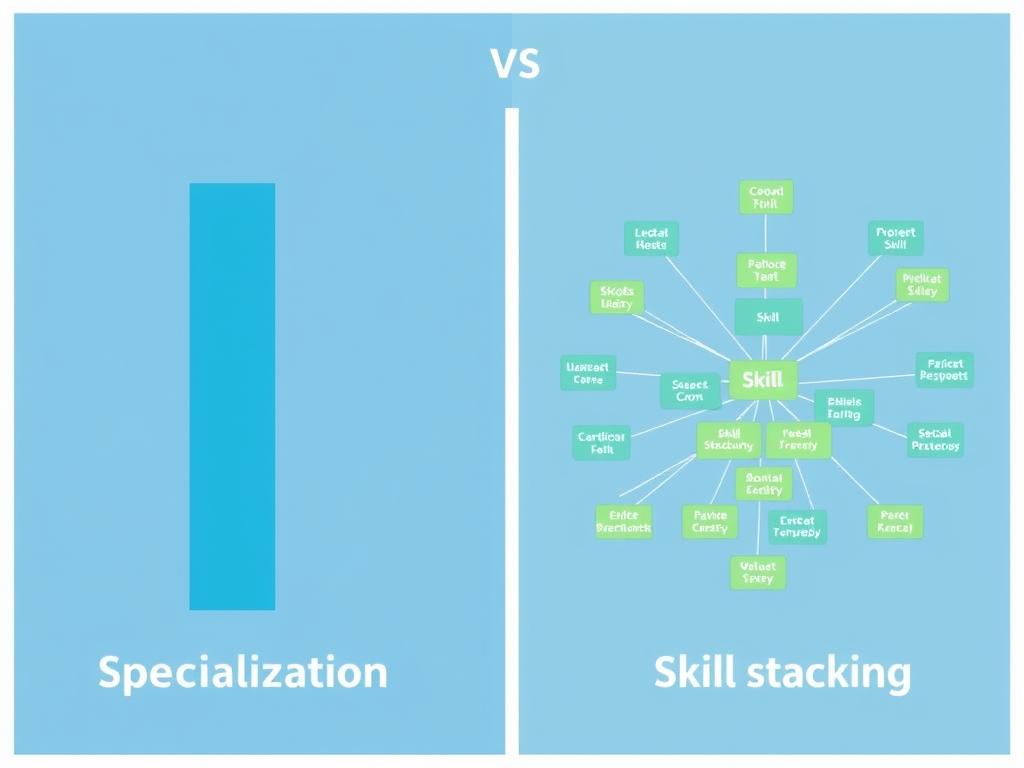
Think of it this way: Skills are like colors – one can paint, but a palette creates masterpieces. A marketing specialist might face competition from thousands of others with similar credentials. But a marketing specialist who also understands data analytics and UX design? That’s a rare and valuable combination.
According to the World Economic Forum, 50% of all employees will need reskilling by 2025 as technology adoption increases. Those with diverse, complementary skill sets will navigate this transition more successfully than hyper-specialists.
✅ The Skill Stacking Advantage
Skill stacking isn’t about being mediocre at many things – it’s about being strategically good at complementary skills that create unique value together. Here’s why this approach works:
Skill Stacking
- Creates a unique professional identity
- Provides multiple income streams
- Offers flexibility to pivot as markets change
- Makes you valuable across departments
- Reduces career vulnerability
Hyper-Specialization
- Limits you to a narrow market
- Creates vulnerability to industry changes
- Often leads to career plateaus
- Can become obsolete with technological shifts
- Typically offers fewer growth pathways
Scott Adams, creator of Dilbert, explains this concept perfectly: “If you want an average successful life, it doesn’t take much planning. Just stay out of trouble, go to school, and apply for jobs you might like. But if you want something extraordinary, you have two paths: become the best at one specific thing or become very good (top 25%) at two or more things.”
The beauty of skill stacking is that becoming “very good” at several skills is far more achievable than becoming the absolute best at one thing – and often more valuable in the marketplace.
🚀 Step-by-Step Guide to Skill Stacking
Building your skill stack isn’t about random accumulation – it requires strategic planning. Here’s how to create your own powerful skill stack:
Step 1: Identify Your Primary Skill ✅
Start with what you’re already good at or what you enjoy most. This becomes the foundation of your stack. Your primary skill should be something you’re willing to continuously improve and that has market value.

For example, if you’re a writer, that’s your primary skill. If you’re a developer, start there. The key is to be honest about what you’re genuinely good at and enjoy.
Step 2: Select 2-3 Complementary Skills That Amplify Your Primary Skill 🔍
Look for skills that create synergy with your primary skill. The best complementary skills are those that:
- Solve problems your primary skill can’t address
- Are in demand in your industry or target industry
- Create unique combinations that few others possess
- Align with your interests and learning style
For instance, if writing is your primary skill, complementary skills might include SEO knowledge, data visualization, or social media marketing – all of which make your writing more valuable in specific contexts.
Step 3: Find Cross-Disciplinary Learning Opportunities 📚
Once you’ve identified your complementary skills, look for efficient ways to learn them:
- Online courses on platforms like Coursera, LinkedIn Learning, or Udemy
- Professional certifications that are recognized in your industry
- Volunteer for projects at work that require these skills
- Join communities and forums where these skills are discussed
- Find a mentor who possesses the skill you want to develop
Step 4: Apply Your Skill Stack in Real Projects 🛠️
Theory without practice has limited value. Look for opportunities to apply your growing skill stack:
- Create side projects that showcase your combined skills
- Volunteer for cross-functional teams at work
- Offer to solve problems that require multiple skills
- Document your process and results to build your portfolio
Step 5: Continually Update Your Stack with Emerging Skills 🔄
The job market evolves constantly. Schedule regular reviews of your skill stack:
- Quarterly assessment of industry trends and emerging skills
- Annual deep dive into how your skill stack is performing
- Regular conversations with mentors about valuable new skills
- Subscribe to industry publications to stay informed
Remember, skill stacking is not a one-time activity but an ongoing career strategy that evolves as you grow professionally.
💡 Real-World Skill Stacking Success Stories
Marketing Specialist + Data Analytics + UX Design
Sarah was a marketing specialist . After recognizing the growing importance of data-driven decisions, she invested six months learning data analytics through online courses while volunteering for UX projects at her company.
Within 18 months, she had created a unique skill stack that allowed her to design marketing campaigns based on user behavior data and measure results with sophisticated analytics. This combination led to a new role as Digital Experience Manager with a 52% salary increase.
“I wasn’t the best data analyst or the best UX designer,” Sarah explains, “but combining these skills with my marketing expertise created a unique value proposition that my company couldn’t find elsewhere.”
Software Developer + Project Management + Business Communication
Michael was a mid-level developer who felt stuck in his career progression. Rather than pursuing advanced technical specialization, he decided to add project management and business communication to his skill stack.
He earned a project management certification while deliberately practicing his presentation and stakeholder management skills. Within two years, he had moved into a technical product manager role that leveraged all three skill areas and increased his income by 35%.
“Technical skills alone weren’t enough to advance,” Michael notes. “The ability to manage projects and communicate effectively with non-technical stakeholders made me much more valuable than just being a better coder.”
📋 Your Skill Stacking Action Plan Worksheet
Ready to build your own skill stack? Use this template to map your journey:
| Step | Questions to Answer | Your Response |
| Identify Primary Skill | What am I already good at? What do I enjoy doing? What has market value? | [Your answer here] |
| Market Research | What skills are in demand in my industry? What problems need solving? | [Your answer here] |
| Select Complementary Skills | Which 2-3 skills would create unique value when combined with my primary skill? | [Your answer here] |
| Learning Plan | How and where will I learn these skills? What’s my timeline? | [Your answer here] |
| Application Strategy | How will I practice and demonstrate my skill stack? What projects can I create? | [Your answer here] |
| Measurement | How will I know my skill stack is working? What outcomes am I seeking? | [Your answer here] |
Ready to start your skill stacking journey?
⚠️ 5 Common Skill Stacking Mistakes to Avoid
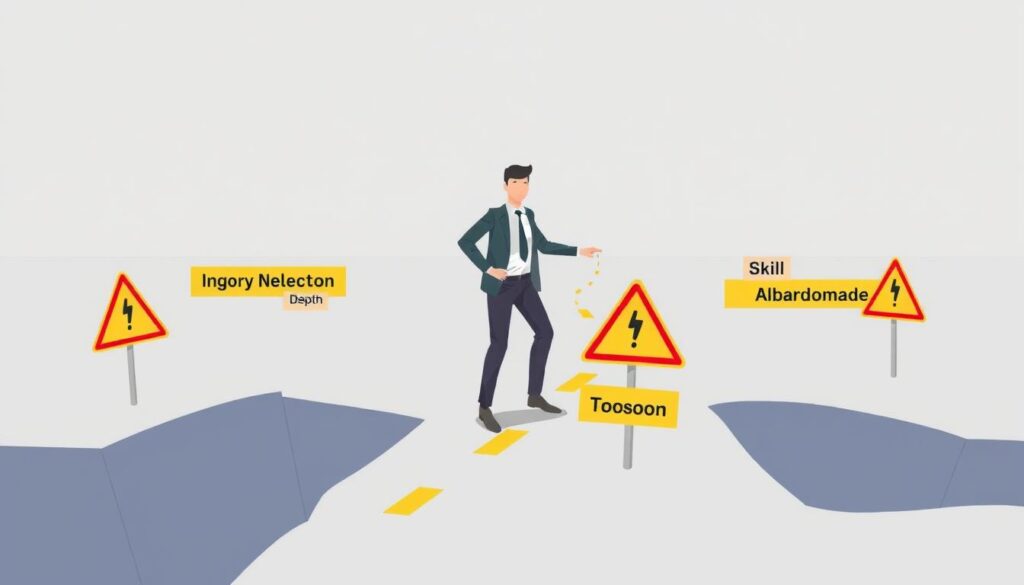
1. Collecting Random Skills Without Strategy
Effective skill stacking isn’t about accumulating random skills – it’s about strategic combinations. Before adding a new skill, ask: “How does this complement what I already know? What unique problems can I solve with this combination?”
2. Neglecting Sufficient Depth
While you don’t need to be the world’s best, you do need to develop each skill to a professional level of competence. Aim to be in the top 25% for each skill in your stack, not just a beginner. Surface-level knowledge rarely adds value.
3. Ignoring Market Demand
Some skill combinations are more valuable than others. Research job postings, industry reports, and salary data to identify which skills are in demand and complement each other in the marketplace.
4. Skill Mismatch
Not all skills create synergy when combined. Focus on skills that enhance each other and create a coherent professional narrative. A random collection of unrelated skills can make you seem unfocused rather than versatile.
5. Abandoning Skills Too Soon
Skill development takes time. Many people give up during the “plateau of despair” – that frustrating period when progress seems slow. Commit to at least 20 hours of focused practice before evaluating a skill’s potential value in your stack.
📊 How to Measure Your Skill Stacking Success
How do you know if your skill stack is working? Look for these indicators:
Quantitative Indicators
- Increased income or salary offers
- More job interviews and opportunities
- Higher response rates to applications
- New project assignments
- Expanded responsibilities
Qualitative Indicators
- Being sought out for unique problems
- Recognition as a valuable resource
- Increased confidence in diverse situations
- Greater career satisfaction
- More autonomy in your role
Track these metrics over time to gauge the effectiveness of your skill stack and make adjustments as needed. Remember that some benefits may take time to materialize as you build proficiency in your complementary skills.
📚 Top 5 Books on Skill Stacking
Accelerate your skill stacking journey with these essential reads:
| Book Title | Author | Key Focus | Price Range | Action |
| Range: Why Generalists Triumph in a Specialized World | David Epstein | How diverse experiences lead to breakthrough success | $14-18 | Shop Now |
| How to Fail at Almost Everything and Still Win Big | Scott Adams | The original skill stacking concept and implementation | $12-16 | Shop Now |
| The Squiggly Career | Helen Tupper & Sarah Ellis | Navigating non-linear career paths with diverse skills | $15-19 | Shop Now |
| Ultralearning | Scott Young | Strategies to master hard skills quickly | $13-17 | Shop Now |
| The Startup of You | Reid Hoffman & Ben Casnocha | Applying entrepreneurial skills to career development | $14-18 | Shop Now |
Prefer reading on Kindle?
Get instant access to these books and thousands more with a Kindle device.
Disclosure: This post contains affiliate links. We may earn a commission at no extra cost to you.
✅ Your Skill Stacking Checklist
Use this checklist to guide your skill stacking journey:

- Identify your primary skill and current proficiency level
- Research market demand for complementary skills in your industry
- Select 2-3 complementary skills that create unique value
- Create a learning plan with specific resources and timeline
- Develop each skill to at least “good enough” professional level
- Apply your skill combination to real projects
- Document your results and build a portfolio showcasing your skill stack
- Update your resume and LinkedIn profile to highlight your unique combination
- Network with professionals who value your specific skill combination
- Review and update your skill stack quarterly
- Continuously scan for emerging skills that could enhance your stack
🚀 Start Your Skill Stacking Journey Today
Skill stacking isn’t just a career strategy – it’s a mindset that embraces versatility, continuous learning, and strategic growth. In a world where change is the only constant, your unique combination of skills becomes your career insurance policy and your ticket to opportunities others can’t access.

As author and entrepreneur Scott Adams puts it: “Every skill you acquire doubles your odds of success.” Start building your skill stack today, and watch as doors open that you never knew existed.
“The future belongs to those who learn more skills and combine them in creative ways.” — Robert Greene